Key takeaways
- Check whether your dishwasher half-load option uses both racks or one rack, with manufacturer examples and a loading decision worksheet.
What's inside
Half load is a model-specific option
Do not assume that a dishwasher’s Half Load setting washes both racks, or that it always means bottom-rack-only operation. Manufacturers use similar labels for different arrangements. Match the option to your complete model number before deciding where to put a small load.
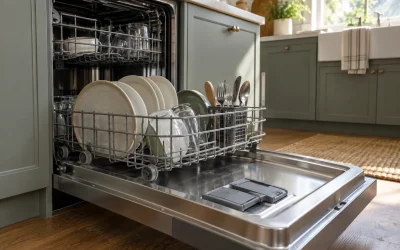
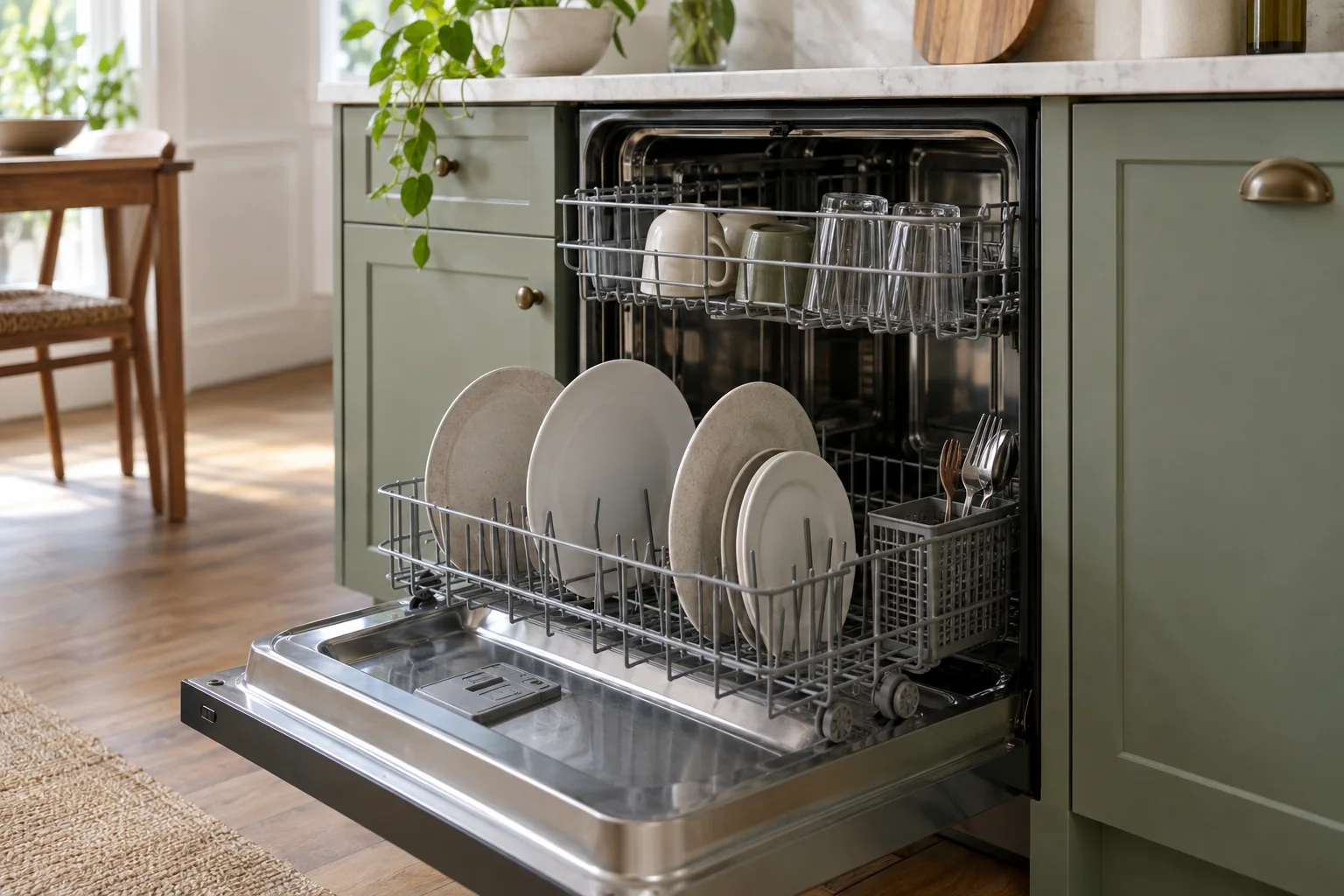
The illustration above shows a generic dishwasher arrangement. It is not an approved half-load loading diagram for a particular machine. Your model’s rack instructions and the care requirements of the dishes determine the correct arrangement.
Two official examples show why the label is insufficient
The Beko manual hosted as DVS05Q20.pdf, whose cover identifies DVS05R20W, DVS05C20W and DVS05J20W, describes its model-dependent Half Load function using both lower and upper baskets. Verify the cover and applicable features, rather than relying on the download filename alone.
By contrast, Samsung Canada’s cycle and option guide describes Lower Rack, called Half Load on older models, as operating the lower-rack nozzle only. It separately describes an Upper Rack option. Not every dishwasher has every option in that general guide.
These examples demonstrate different meanings. They do not authorize either arrangement on an unidentified dishwasher. Find the program and option instructions for your actual appliance, including its regional version.
Read the option description before moving dishes
Write down the model code from the appliance identification information and match it with the manual’s cover or model list. Search that manual for Half Load, Lower Rack, Upper Rack or the exact wording on your controls. Check any notes attached to the program compatibility table.
Record whether the feature limits the active rack, changes a program for a small load, or offers a selectable zone. A button icon alone may not explain those differences. If the instructions are unclear, ask the manufacturer’s support team using the model code and the option name.
Keep item care restrictions in the decision. A plastic container marked top-rack-only should not move to the lower rack simply to suit a lower-rack-only option. Use a compatible arrangement and program instead of treating the small-load feature as mandatory.
Use a small-load decision worksheet
| Question | Record | Decision |
|---|---|---|
| Which model? | Complete code and matching manual | Reject instructions for another model |
| Which rack is active? | Both, lower, upper or another defined zone | Place items only as permitted |
| Which program supports it? | Compatibility table entry | Choose an allowed combination |
| What can each item tolerate? | Dishwasher and rack restrictions | Keep material limits intact |
| How is detergent specified? | Manual and detergent directions | Do not assume a half dose |
| How is activation confirmed? | Model’s indicator or display behavior | Check before starting |
This worksheet deliberately has no universal button sequence. Controls, option availability and remembered settings vary. Follow the relevant start instructions instead of copying a sequence from a different machine.
Worked example: a mixed small load
Illustrative household: the load contains four dinner plates, two mugs and one container whose maker specifies the upper rack. The dishwasher’s verified instructions say its small-load option activates only the lower rack. Putting everything in the bottom basket would conflict with the container’s care instructions.
One sensible response is to use an allowed full-rack program with the items in their appropriate positions. Another is to wash a suitable lower-rack load using the supported option and handle the remaining item separately according to its instructions. The choice depends on what is needed and what the actual manuals permit.
On a different machine whose small-load feature permits both baskets, the arrangement could be different. The useful decision is not whether the load looks half full; it is whether the selected program, active rack and individual items agree.
Do not infer a percentage saving or detergent rule
Half Load does not by itself establish half the water, half the electricity or half the duration. Use published data for the actual program and option if you need those comparisons. A label is not a numerical consumption claim.
Similarly, do not cut open or divide a detergent pod to create an assumed half dose. Use the detergent product as directed and follow the appliance’s dosing guidance. Where a manual provides an adjustable powder or liquid dose, apply its stated conditions rather than inventing a percentage from rack occupancy.
Make the successful setup easy to repeat
Once you have confirmed the correct arrangement, save a short note with the model code, program, option and rack restriction. Keep it near the manual or in a household appliance folder. A dated screenshot of the relevant instruction is more useful than a vague note saying use half load for a few dishes.
Before each run, follow the normal loading checks in the manual, including clear spray movement and detergent-dispenser access. A supported small-load option does not compensate for obstructed loading. Recheck the setup when the dishes or selected program change.