Key takeaways
- One basket: Fine for compact units, but it becomes a shallow “top drawer” rather than a complete organizing system.
- Two or three sliding baskets: Better for separating meat, vegetables, and prepared food. Confirm that the baskets can be lifted out when the lid is only partly open.
- Adjustable dividers: Useful for stopping bags from sliding into an inaccessible corner.
- Interior light: More useful than it sounds in a dark garage, particularly with a deep 10–15-cubic-foot cabinet.
- Labels and inventory: Keep a list on the lid or wall, mark dates on every package, and place newer food below or behind older food.
The best chest freezers for most homes are garage-ready models with 5–7 cubic feet of usable space, removable baskets, an adjustable thermostat, and an energy use near 200–350 kWh per year; larger households should step up to 10–15 cubic feet only when they have a clear loading and access plan.
Best chest freezers by household situation
| Situation | Best size and format | What matters most | Likely trade-off |
|---|---|---|---|
| Small apartment or limited utility room | 3.5–5 cubic feet | Small footprint, low noise, front-access drain | Less usable floor area inside; frozen packages stack quickly |
| Two adults buying occasional bulk food | 5–7 cubic feet | One or two lift-out baskets and an adjustable divider | Requires labeling because the bottom layer is difficult to reach |
| Family with children or pets | 7–10 cubic feet | Lockable lid, stable hinge, rounded cabinet corners | Full loads are heavy and need deliberate organization |
| Large family, hunter, or serious bulk shopper | 10–15 cubic feet | Multiple baskets, interior light, fast-freeze function | Needs more clearance, more floor space, and a stronger moving plan |
| Unheated garage | Garage-ready 5–15 cubic feet | Specified operating range and temperature alarm | Garage temperature extremes can still increase energy use |
Our practical picks by type
Best all-purpose choice: a 5–7 cubic-foot garage-ready freezer
This is the most balanced category for many households. It can hold several weeks of meat, frozen vegetables, prepared meals, or seasonal produce without dominating a garage or laundry room. Look for two baskets rather than one if possible, plus a thermostat that can be reached without unloading the cabinet.

Midea 3.5 Cu.ft Chest Freezer, Fridge Freezer Convertible with LED Light
Included for 'Best Chest Freezers for Home, Garage, and Bulk Storage' because the listing specifies Fridge Freezer Convertible with LED Light, details this guide uses to compare options.
View on Amazon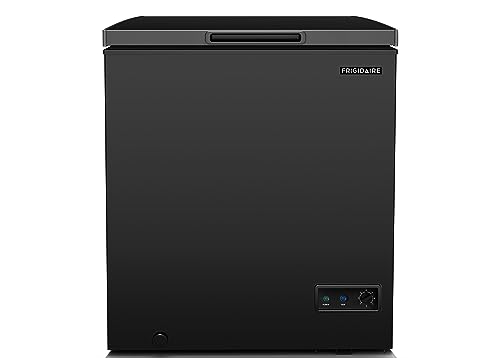
FRIGIDAIRE EFRF5003-BLACK Chest Deep Freezer-Garage-Ready, 5.0 Cu. Ft. Capacity, Black-Adjustable Thermostat-Removable Vinyl Coated Wire Basket-Easy Defrost Drain
Included for 'Best Chest Freezers for Home, Garage, and Bulk Storage' because the listing specifies 5.0 Cu. Ft. Capacity, details this guide uses to compare options.
View on Amazon
Hamilton Beach 17 cu ft Chest Deep Freezer - White, GARAGE READY Food for Large Family, Storage Basket, Space-Saving Flat Back, Stay-Open Lid, Front-Access Drain, for Basement, Laundry Room, Cottage
Included for 'Best Chest Freezers for Home, Garage, and Bulk Storage' because the listing specifies White and GARAGE READY Food for Large Family, details this guide uses to compare options.
View on Amazon
14 cu ft Chest Freezer - White, Large Storage for Families, Space-Saving Flat Back, Front Drain, Garage Ready - By Hamilton Beach
Included for 'Best Chest Freezers for Home, Garage, and Bulk Storage' because the listing specifies White and Large Storage for Families, details this guide uses to compare options.
View on AmazonModels from established brands such as GE, Frigidaire, Midea, and Danby commonly occupy this size range. Features vary by model and year, so confirm the actual operating-temperature specification rather than assuming that a brand-wide “garage ready” label applies to every freezer.
Best for tight spaces: a 3.5–5 cubic-foot compact chest freezer
A compact freezer fits beneath a workbench or along a short garage wall, but its outside dimensions do not tell the whole story. Allow at least 3 inches of air space on the sides and back, and about 12–18 inches above the lid if you want to open it comfortably. A freezer measuring roughly 33 inches wide by 22 inches deep can therefore need a service area about 39 inches wide by 28 inches deep, not including walking space.
Compact units are easiest to use when the household freezes flat packages. Upright containers and bulky cartons waste the limited vertical space. A single lift-out basket is useful for small items but does not create true compartments; use labeled bins or reusable bags below it.
Best for family bulk storage: a 7–10 cubic-foot model with multiple baskets
This size offers a meaningful increase in usable capacity without the access problems of the largest chests. Choose two or three sliding baskets, a divider, an interior light, and a lid that stays open at several angles. Families should also consider a lock or control lock if children can reach the lid.
A 9-cubic-foot freezer may have approximately 45–50 inches of exterior width and weigh around 100–140 pounds empty, depending on insulation and construction. Check the boxed dimensions before purchase: packaging can add several inches, and a narrow doorway or stair landing may be the real limitation.
Best for maximum capacity: a 10–15 cubic-foot chest freezer
Large chest freezers make sense for a second home, a large family, a hunting household, or anyone who regularly buys a quarter or half animal. They are less convenient for everyday access. Frozen food at the bottom can be difficult to retrieve, and a full cabinet can contain several hundred pounds of food.
Before choosing one, measure the path from delivery location to its final position. A 14-cubic-foot freezer may require more than 55 inches of wall width, and its empty weight can exceed 150 pounds. Never plan to move a full chest freezer casually; unload it, use an appliance dolly, and keep it upright as much as possible. Follow the manufacturer’s waiting period before plugging it in if it was transported on its side.
Capacity, footprint, and usable storage
Advertised cubic feet describe interior volume, not convenient storage. Baskets, compressor humps, sloped walls, and clearance around the lid reduce the space you can use efficiently. A useful rule is to reserve roughly 1.5–2 cubic feet of freezer space per household member for ordinary storage, then add capacity for bulk purchasing or meal preparation.
For example, a 5-cubic-foot chest can suit two people who buy modest quantities. A family of four that stores meat, frozen meals, and garden produce will usually be happier with 7–10 cubic feet. Buying a larger freezer than you can keep reasonably full also increases the temptation to lose track of dates and waste food.
Garage-ready operation and energy consumption
Garage-ready does not mean the freezer can operate efficiently in every climate. It generally indicates that the design and controls are intended for a wider ambient-temperature range than a basic indoor unit. Read the manual for the minimum and maximum surrounding temperatures. In a hot garage, the compressor may run longer; in a very cold garage, some models may not maintain safe food temperature reliably.
Energy use varies with size, insulation, room temperature, loading, and how often the lid is opened. As a broad comparison, compact chest freezers often use about 150–250 kWh per year, 5–7-cubic-foot models about 200–350 kWh, and 10–15-cubic-foot models about 300–500 kWh. Use the yellow EnergyGuide label and your local electricity rate for a better estimate. A freezer in a shaded, moderately cool garage may use less electricity than the same model in a hot utility room.
Temperature recovery matters more than a flashy control panel
Every lid opening lets cold air spill out. A well-insulated cabinet, tight gasket, and correctly sized compressor help the freezer return to its set temperature after loading. Fast-freeze or power-freeze settings can help with a large load of fresh food, but they consume more electricity while active and should not be left on indefinitely unless the manual permits it.
For food safety, use a separate freezer thermometer rather than relying only on the dial. The target is 0°F (−18°C) or colder. A temperature alarm is especially valuable in a garage, during power interruptions, or when the freezer is used for expensive meat.
Basket design and organization
- One basket: Fine for compact units, but it becomes a shallow “top drawer” rather than a complete organizing system.
- Two or three sliding baskets: Better for separating meat, vegetables, and prepared food. Confirm that the baskets can be lifted out when the lid is only partly open.
- Adjustable dividers: Useful for stopping bags from sliding into an inaccessible corner.
- Interior light: More useful than it sounds in a dark garage, particularly with a deep 10–15-cubic-foot cabinet.
- Labels and inventory: Keep a list on the lid or wall, mark dates on every package, and place newer food below or behind older food.
Use straight-sided freezer-safe bins that are low enough to remove without scraping the lid. Avoid filling cardboard cartons directly against the inner walls if they prevent air circulation or become damp. Do not use the freezer as a bench or seat; the lid, hinges, and cabinet are not generally designed for body weight.
Defrosting and maintenance
Most chest freezers are manual-defrost models. That design usually uses less energy and provides more storage efficiency than an automatic-defrost freezer, but ice buildup eventually reduces capacity and insulation performance. Defrost when the ice reaches roughly 1/4 inch thick, or sooner if the lid no longer closes properly.
Move food to coolers, unplug the freezer, and let the ice melt naturally. Use towels to control water. Never chip ice with a knife or pour boiling water into the cabinet; either can damage the liner or refrigerant system. A front drain makes the job easier, but verify where the water will exit before starting.
Clean the gasket with mild soapy water and check that it seals evenly. Vacuum dust from accessible condenser areas according to the manual. The gasket and lid hinges are among the parts most likely to show wear first, especially in a busy household.
What to budget
Compact chest freezers commonly cost about $180–$350, mid-size garage-ready models about $300–$600, and larger 10–15-cubic-foot models about $500–$900. Higher prices may buy better insulation, alarms, lighting, basket systems, or a longer warranty, but capacity alone does not guarantee easier access. Also budget for a heavy-duty appliance dolly, freezer bins, a thermometer, and possibly a dedicated electrical outlet.
Final buying checklist
- Measure the freezer, the packaging, every doorway, and the full lid-opening area.
- Confirm garage operating temperatures for your climate.
- Compare annual kWh, not just the purchase price.
- Choose enough baskets and bins to reach the bottom without unloading everything.
- Check for a front drain, temperature alarm, lock, interior light, and fast-freeze mode.
- Plan how two adults will move the empty unit and how it will be secured in its final position.
- Buy the smallest capacity that accommodates your real shopping habits with room for air circulation and organization.