Our Top Picks
 COMFORT ZONE Reversible Twin Window Fan with 3-Speeds9 inch (3-Speed)4.88 x 22.5 x 10.88 inches4.6 poundsCheck on Amazon
 shinic 3-Speeds Window Fan with 180°+90° Rotatable FansMedium4 x 21.65 x 11.02 inches6 poundsCheck on Amazon
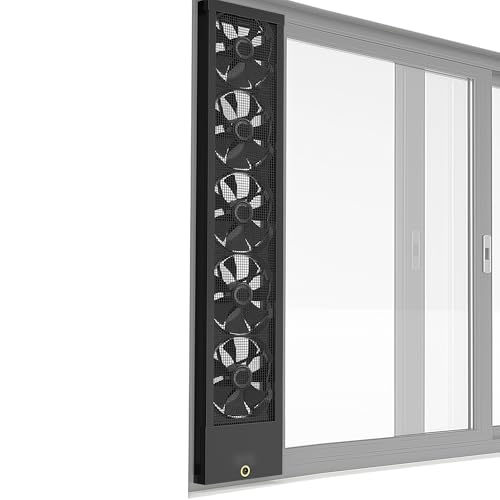 31.5-33.5 Inch Vertical Window Fan for Sliding Windows31.5-33.5 in / 80-85 cm1.57 x 6.3 x 31.5 inches5.04 poundsCheck on Amazon
 19.7-21.6 Inch Vertical Window Fan for Sliding Windows19.7-21.6 in / 50-55 cm1.57 x 6.3 x 19.7 inches3.14 poundsCheck on Amazon
Casement windows crank outward on a side hinge, so a standard expandable window fan will not fit them; the practical choices are a slim fan placed on the sill or in the opened sash with a panel kit, a fan built for a hinged opening, or an indoor fan that works with the open window. The best fit depends on how far your casement opens and whether the sash has a screen. This guide explains the options and what to measure before buying.
Why casement windows are harder to fit
Most window fans are made for sliding or double-hung windows, where the fan rests on the sill and the sash closes down on it. A casement swings outward, leaving an angled opening with no sash to hold a fan. Installing a typical expandable fan can leave gaps or an unstable setup. Look for a fan that the maker lists as suitable for casement windows, or use an indoor placement.
COMFORT ZONE Reversible Twin Window Fan with 3-Speeds & Expandable Width | Draw Cool Air In or Manually Reverse to Pull Warm Stale Air Out, Removeable Bug Screen, ETL Certified for Home and Kitchen
Chosen because it specifies Removeable Bug Screen and ETL Certified for Home and Kitchen.
View on Amazonshinic 3-Speeds Window Fan with 180°+90° Rotatable Fans, Manual Reversible, Vertical Window Fan with Rigid & Accordion Expanders, Width Adjustable (21.65" to 33.27"), Ideal for Home, Kitchen, Bedroom
Chosen because it specifies Manual Reversible and Vertical Window Fan with Rigid & Accordion Expanders.
View on Amazon31.5-33.5 Inch Vertical Window Fan for Sliding Windows Exhaust Only | Align Perfectly with Window Top and Bottom Tracks Tool-Free With Variable Speed for Bedrooms Smoky Spaces Hot Areas
Picked as a relevant option in this category.
View on Amazon19.7-21.6 Inch Vertical Window Fan for Sliding Windows Exhaust Only | Align Perfectly with Window Top and Bottom Tracks Tool-Free With Variable Speed for Bedrooms Smoky Spaces Hot Areas
Picked as a relevant option in this category.
View on AmazonAt a glance
| Approach | Best for | Key points | Limits |
|---|---|---|---|
| Fan listed by the maker as casement compatible | Buyers who want a mounted fan | Uses brackets or a panel that fits the opening; confirm the stated size range | Few models; check availability |
| Box or tower fan placed indoors at the open window | Most renters | No mounting needed; set to blow in or out | Takes floor space; open sash must stay secure |
| Slim sill-mounted window fan with side panels | Casements with deep sills | Panels can fill the gap if the casement opens fully | Fit varies; may need additional sealing |
| Window fan kit with adjustable frame | Odd-shaped openings | Adjustable frame and panels | More setup and a security check |
| Window air conditioner for casements | Hot climates | Models made for casement windows exist from some makers | More expensive and heavier |
Measure before you buy
- Measure the opening width and height with the sash open to the angle you will use.
- Note the depth of the sill and whether a screen sits inside or outside.
- Check how far the crank allows the sash to open.
- Check whether the window can be locked when partly open.
- Compare against the maker’s stated fan dimensions and mounting method.
Option 1: casement-compatible fans
A few makers describe fans meant for casements, usually with brackets or a custom panel. If you find one, read the manual on installation, and check that the fan will not strain the hinge or crank. Reviewers commonly point out that casement fans are less common than standard window fans, so check the current availability and fit list on the maker’s page.
Option 2: an indoor fan at an open window
The simplest and most flexible option is a box fan, tower fan or pedestal fan placed near the open casement. For exhausting hot air, point it toward the window. For drawing in cool air, open another window on the opposite side and point the fan inward. Brands such as Lasko and Honeywell sell box and tower fans with multiple speeds. This approach avoids mounting but lets in insects unless the screen stays in place.
Option 3: a fan on the sill
If the sill is deep and the casement opens fully, a slim twin fan with expandable side panels may sit on the sill, with the sash resting against it. Only do this if the setup is stable and the window can be secured. Do not rely on the crank mechanism to hold weight.
Safety notes
- Do not block an escape route in a bedroom window.
- Secure any fan so it cannot fall outside or inside.
- Follow the manual for plug and cord use, and avoid extension cords unless allowed.
- Remove or close the window in rain, as most fans are not weather resistant unless the maker says otherwise.
- Keep fingers and objects away from the blades, and unplug before cleaning.
- If a fan overheats or smells, stop using it.
Features to compare
Reversible airflow
Useful for switching between intake and exhaust.
Thermostat or timer
Some models include a thermostat or timer, which can automate nightly cooling.
Speeds and noise
Multiple speeds help you balance airflow and noise.
Remote control
Convenient for tower fans placed across a room.
Budget tiers
Budget
Basic box fans. They work well in an indoor position by the window.
Mid-range
Tower fans with remotes and timers, or reversible fans with adjustable panels.
Premium
Smart tower fans, casement-specific kits and casement window air conditioners.
Pick X if…
| If you… | Pick |
|---|---|
| Rent and cannot modify the window | Indoor box or tower fan near the open casement |
| Want a mounted fan | A fan the maker lists as casement compatible |
| Have a deep sill and fully opening sash | Slim sill-mounted twin fan with panels, after a stability check |
| Want automated cooling | A fan with thermostat or timer |
| Live in a hot climate | A casement window air conditioner |
Alternatives
- Cross-ventilation with two open windows: a simple approach with one fan in the room.
- Ceiling fan: circulates air in the room and pairs well with open casements.
- Portable air conditioner with a window kit: some kits accommodate casements.
- Replacing the sash panel with a vented insert: a more permanent solution that may need a professional.
Getting the most from an open casement
A casement window opens wide, which gives it good airflow potential even without a mounted fan. Cranking the window fully open and pointing a fan at the opening lets you move a lot of air with a modest fan. Angle the sash so it catches the breeze and directs it into the room, a trick some households use on windy evenings. On a windless night, a fan placed indoors and pointed outward helps pull hot air from the room, provided that another window is open elsewhere to supply replacement air.
Screens, insects and security
Casement screens usually sit on the inside of the window, which makes them easy to keep in place when you use an indoor fan. Keep the screen intact to block insects, and check that the sash lock can still secure the window in a partly open position if the hardware supports it. Many casements have a limiter that holds the sash at a fixed angle, which can improve both security and safety for children. If you rely on an open window at night, think about ground-floor security and local conditions.
Tower, box and pedestal fans compared
| Fan type | Best for | Limits |
|---|---|---|
| Box fan | Strong airflow for a low tier | Bulky, fewer controls |
| Tower fan | Narrow footprint, remote and timer on many models | Less raw airflow than a box fan |
| Pedestal fan | Adjustable height and angle | Needs floor space and a stable base |
| Window air conditioner for casements | Active cooling | Heavy and needs careful installation |
When to ask a professional
If you want a permanent installation, such as a vented panel or a casement-fitted fan, ask a window installer or a handyperson who works with your window brand. Altering the sash or frame can affect the warranty and the seal, so follow the window maker’s guidance. For air conditioners, follow the manual on support brackets and electrical requirements.
Placement tips for better airflow
Place the fan a short distance back from the window rather than hard against the sash, so air can flow around it and the hinge is not stressed. Aim it at an angle if the sash blocks part of the opening. Keep furniture and curtains clear of the blades and of the path of air. In a multi-room home, open an interior door so air can pass through, and close doors to rooms you are not cooling.
Frequently Asked Questions
Can I use a normal window fan in a casement window?
Generally not, because the window opens outward and has no sash to hold the fan. Use a fan the maker lists as casement compatible or place a fan indoors.
Is it safe to put a fan on the sill?
It can be if the fan is stable and the window secure. Do not leave it where it could fall, and follow the manual.
Which direction should the fan blow?
Blow outward to exhaust hot air during the day, and inward to draw cool air at night, with another window open for flow.
Will the screen still work?
Keep the screen in place if you are using an indoor fan. A mounted fan may require removing it, which lets insects enter.
Are there casement window air conditioners?
Some makers sell models designed for casement windows. Check the size range and weight limit before buying.
Can I leave the fan on when I leave the house?
Follow the manual. Many people prefer to turn fans off when away, and a secure window is important for security.