
Key takeaways
- Audit your practice: Count how many minutes you spend standing versus on the floor. That ratio should decide the thickness, not comfort in the shop.
- Density is the escape clause: A dense thick mat is far more stable than a soft one of the same depth. If you need padding and balance, buy density.
- Test single-leg compression: Stand on one foot and shift your weight. If the surface keeps moving under you, that mat will undermine every balance pose.
- Identify the pressure points: Knees, elbows, hip bones and tailbone are where thin mats hurt. If your routine loads those, thickness earns its place.
- Consider two mats: A thin mat for flow and a thick one for floor work costs less than one premium mat and solves both problems properly.
What's inside
There is a specific moment when a thick mat betrays you. You are in tree pose, the standing foot settles, and the foam under the ball of your foot compresses a fraction more than the foam under your heel. Your ankle corrects, which shifts the pressure, which compresses a different part of the foam, and now you are chasing a surface that will not hold still. It has nothing to do with your balance and everything to do with buying 10mm of soft foam for a practice built on standing poses.
The inverse problem is just as real. Take a 3mm travel-style mat onto a hard floor and every kneeling pose becomes a negotiation with your patella. So thickness is not a quality scale where more is better — it is a dial you set according to how much of your practice happens on your feet versus on the floor. The mats below span roughly 3mm to 10mm, and each is placed where it belongs on that dial.
As an Amazon Associate we earn from qualifying purchases at no extra cost to you. Product prices and availability are accurate as of the date shown and are subject to change.


Quick Comparison
| Product | Best For | Standout Feature | Watch Out For |
|---|---|---|---|
| CAP Non-Slip Yoga Mat | Standing sequences and balance | Thin profile keeps you connected to the floor | Little protection for knees and elbows |
| CAP Barbell 1/2-Inch High Density Mat | Padding without total instability | Density that resists uneven compression | Still noticeably soft in single-leg poses |
| Gaiam Thick NBR Yoga Mat | Mixed floor and standing work | Middle-ground cushioning with a cinch strap | Compresses under a single standing foot |
| Amazon Basics Extra Thick Exercise Mat | Predominantly floor-based routines | Generous cushioning at a modest price | Balance poses feel vague and unsteady |
| Fitvids 1/2-Inch Extra Thick Mat | Long floor sessions | High density holds shape through the session | Half an inch is a lot underfoot |
| KEEP Extra Thick NBR Mat, 10mm | Almost entirely floor-based work | Maximum cushioning at 10mm | Genuinely unstable for standing balance |
How to Choose
- Audit your practice: Count how many minutes you spend standing versus on the floor. That ratio should decide the thickness, not comfort in the shop.
- Density is the escape clause: A dense thick mat is far more stable than a soft one of the same depth. If you need padding and balance, buy density.
- Test single-leg compression: Stand on one foot and shift your weight. If the surface keeps moving under you, that mat will undermine every balance pose.
- Identify the pressure points: Knees, elbows, hip bones and tailbone are where thin mats hurt. If your routine loads those, thickness earns its place.
- Consider two mats: A thin mat for flow and a thick one for floor work costs less than one premium mat and solves both problems properly.
Top Picks Reviewed
Best for Balance Work: CAP Non-Slip Yoga Mat
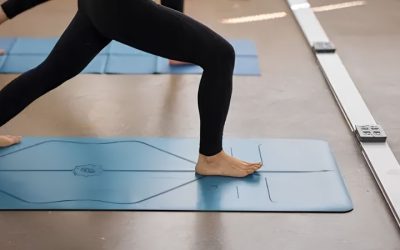
A thin mat lets you feel the floor, and feeling the floor is most of what balance is. Standing sequences, warrior transitions and single-leg poses are all noticeably steadier on a slim textured surface than on any amount of soft foam.
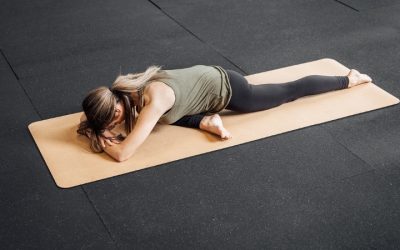
The honest cost is joint comfort. Kneeling poses, forearm planks and anything that puts a hip bone on a hard floor will be uncomfortable. Folding the mat over at the contact point, or adding a towel, is the usual fix.
Best Balanced Compromise: CAP Barbell 1/2-Inch High Density Mat
Density is what makes this work. At half an inch it provides real cushioning for knees and spine, but because the foam is firm it does not deform unevenly under a single foot the way soft mats of the same thickness do.
It is still half an inch. Extended single-leg balance work will feel less precise than on a thin mat, and practitioners who prioritise standing poses above everything else may prefer to give up the padding.
Best Middle Ground: Gaiam Thick NBR Yoga Mat
For a practice that mixes standing flow with floor work in roughly equal measure, cushioned NBR foam is a sensible landing spot: comfortable enough for seated and supine sequences, not so deep that standing poses become an exercise in ankle stabilisation.
NBR foam is softer than dense PVC at similar thickness, so the compression underfoot is still noticeable. If your sequences hold standing poses for long counts, that softness will register.
Best for Floor-Based Practice: KEEP Extra Thick NBR Mat
If your routine is restorative work, core training, physiotherapy exercises or long supine sequences, 10mm of NBR foam across a 72 by 24 inch surface is simply more comfortable than anything thinner, and comfort is what determines whether you finish the session.
It is not a mat for standing poses. Balance work on this surface is genuinely difficult, and attempting a long tree pose on 10mm of soft foam is more a test of the mat than of you. Match it to a floor-based practice and it is excellent.
Frequently Asked Questions
What thickness is standard for yoga?
Traditional mats sit around 3mm to 5mm, which suits standing-heavy practice. Thicker mats from 6mm upward are aimed at floor work, joint comfort and general exercise rather than classical yoga sequences.
Does a thick mat make balance poses harder?
Yes, measurably. Soft foam compresses unevenly under a single foot, which forces continuous ankle correction. Density mitigates this more effectively than any other factor.
Is it worth owning two mats?
Often, and it costs less than most people assume. A thin mat for flow and a thick one for floor work solves a problem that no single thickness handles well.
How do I protect my knees on a thin mat?
Fold the front edge of the mat back under your knee for kneeling poses, or keep a folded towel or small pad nearby. Both work better than switching to a mat that undermines everything else.
Final Thoughts
Set the thickness dial by what your practice actually contains. Standing-heavy sequences belong on the thin CAP mat, floor-based work is far more comfortable on the KEEP 10mm, and the dense CAP Barbell half-inch mat is the best attempt at serving both. If you cannot pick a side, buy density rather than depth — it is the specification that lets a cushioned mat still feel stable underfoot.
Write Your Review
No reviews yet. Be the first to share your experience!