
Key takeaways
- Time the weight change: A dial takes about three seconds, a spin-lock collar takes twenty to forty per handle. Multiply by the number of exercises in your session and you get the real cost of a cheaper mechanism.
- Keep the weights within arm’s reach of the training spot: Equipment stored in a closet gets used roughly half as often as equipment stored where you train. Choose something you are willing to leave visible.
- Pick a range with useful jumps: Five-pound increments in the light range and ten-pound jumps higher up are what allow steady progression. Sets with only three widely spaced options force you to stall or overreach.
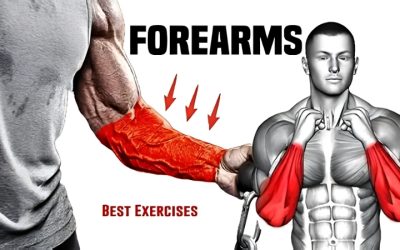
- Handle diameter affects grip fatigue: Thick, aggressive handles wear out forearms before the target muscle on high-rep sets. For circuit-style training, a moderate knurled grip is more comfortable and more productive.
- Have a plan on the wall: The single biggest time sink in home training is deciding what to do. A visible chart or routine turns a twenty-minute window into twenty minutes of work rather than twelve.
What's inside
Training at home succeeds or fails on friction. A gym membership fails because of the drive; a home setup fails because of the four minutes spent unscrewing collars in the middle of a twenty-minute session. If your realistic window is half an hour before work, the equipment question is not which dumbbells are strongest — it is which ones let you move from a set of goblet squats to a set of lateral raises without breaking rhythm.
That reframes the whole category. A 600 lb hex rack is the fastest equipment in existence if you have the room for it, because there is no adjustment at all. In an apartment corner, a dial-based pair is the fastest thing that fits. A plate-and-collar set is the slowest of the three but buys you a weight ceiling neither of the others can touch. The six picks below are sorted by that tension between speed, ceiling and footprint.
As an Amazon Associate we earn from qualifying purchases at no extra cost to you. Product prices and availability are accurate as of the date shown and are subject to change.

#1 Pick

#2 Pick

#3 Pick

#4 Pick

#5 Pick

#6 Pick

#7 Pick

#8 Pick
Quick Comparison
| Product | Best For | Standout Feature | Watch Out For |
|---|---|---|---|
| Dial Adjustable 25LB Pair | Short circuit-style sessions | Instant dial between ten loads | 30 lb per-hand ceiling |
| Amazon Basics Neoprene Weights | Warm-ups and finishers | Zero setup, always ready | Very limited weight range |
| HANDBODE Hex Set with Rack | Rooms with space to spare | No adjustment time at all | Takes a dedicated corner |
| GOIMU 4-in-1 Adjustable Set | Varied weekly programming | Four modes from one plate pool | Slow to switch configurations |
| 20–90lb 4-in-1 Connector Set | Strength-focused sessions | Reaches 90 lb for hinges | Not suited to fast supersets |
| Palace Learning 3-Pack Posters | Deciding what to do fast | Ready routines on the wall | Reference only, no progressions |
How to Choose
- Time the weight change: A dial takes about three seconds, a spin-lock collar takes twenty to forty per handle. Multiply by the number of exercises in your session and you get the real cost of a cheaper mechanism.
- Keep the weights within arm’s reach of the training spot: Equipment stored in a closet gets used roughly half as often as equipment stored where you train. Choose something you are willing to leave visible.
- Pick a range with useful jumps: Five-pound increments in the light range and ten-pound jumps higher up are what allow steady progression. Sets with only three widely spaced options force you to stall or overreach.
- Handle diameter affects grip fatigue: Thick, aggressive handles wear out forearms before the target muscle on high-rep sets. For circuit-style training, a moderate knurled grip is more comfortable and more productive.
- Have a plan on the wall: The single biggest time sink in home training is deciding what to do. A visible chart or routine turns a twenty-minute window into twenty minutes of work rather than twelve.
Top Picks Reviewed
Best for Fast Sessions: Dial Adjustable 25LB Pair
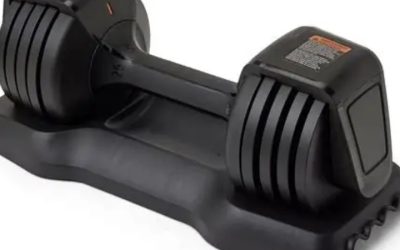
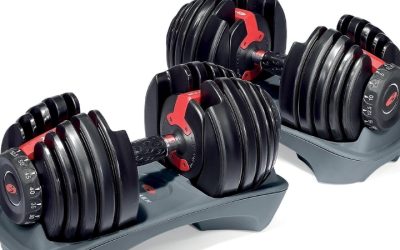
Ten weight settings per hand from 5 to 30 lb, selected by a single turn, makes this the natural choice for anyone training in short blocks. You can run a press, row, squat and raise circuit without leaving the mat, which is exactly what a compressed schedule requires.
The 30 lb ceiling is the honest constraint. Upper-body pressing and all isolation work stay challenging for a long time; squats and Romanian deadlifts will not. Expect to add a heavier option eventually rather than assuming this is a permanent solution.
Best Zero-Setup Pair: Amazon Basics Neoprene Weights
There is real value in a pair that requires no decision at all. Kept beside the mat, these get used for warm-up sets, rear delt work and finishers on days when nothing more ambitious is going to happen.
They will never be a primary training tool. The useful band tops out around 15 lb, and the neoprene shell is best kept out of hot storage where it eventually hardens and cracks along the seam.
Fastest Overall: HANDBODE Hex Set with Rack
If floor space allows, nothing beats grabbing a fixed pair. Zero adjustment, zero mechanism, and the flat hex faces support push-up and renegade row positions that round handles make unstable. The 100 to 600 lb tiers let you buy only the range you use.
The requirement is a permanent corner and a floor that can take it. Loaded racks concentrate a lot of weight on a small footprint, so ground-floor rooms and concrete are the natural home for one.
Best for Programme Variety: GOIMU 4-in-1 Adjustable Set
Configurations from 32 to 94 lb plus barbell, kettlebell and push-up bracket modes let one purchase support swings on Monday and bench-style pressing on Thursday. For a single-room gym that breadth is hard to match.
Switching modes is a deliberate act, not something to do mid-circuit. Plan a session around one configuration and this works beautifully; try to change on the fly and it will eat your training window.
Best Weight Ceiling: 20–90lb 4-in-1 Connector Set
Five configurations up to 90 lb loaded, plus a connector bar for barbell work, means genuine strength progression stays available for years. For hinges, heavy rows and split squats it is the only option here with adequate load.
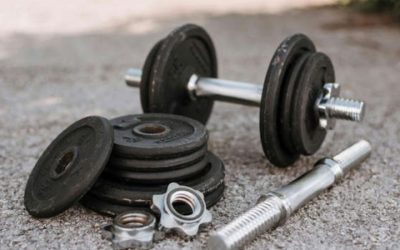
It is deliberately not a speed tool. Threaded collars need re-tightening and plate swaps take time, so treat this as strength equipment rather than circuit equipment, and check collar tension before every overhead set.
Best Time-Saver: Palace Learning 3-Pack Posters
Three laminated volumes on the wall remove the deliberation phase entirely. Pick a body part, pick four movements, start. That sounds trivial and is often the difference between a session happening and not happening.
They document positions rather than execution. Tempo, breathing and the common technique errors are not covered, so anyone new to loaded hinging should verify form separately before adding weight.
Frequently Asked Questions
Can a twenty-minute dumbbell session actually build strength?
Yes, provided the sets are genuinely hard and you cover a press, a pull and a lower-body movement. Three sets of each at a weight that becomes difficult by rep ten is more effective than an hour of undirected work.
How fast are dial dumbbells compared to plate-loaded ones?
Roughly ten times faster in practice. A dial change is a few seconds; unloading and reloading two plates per handle plus collars is commonly thirty to sixty seconds, which is enough to break the flow of a circuit.
Do I need heavy dumbbells for legs, or is that pointless at home?
Legs need meaningful load. Bodyweight squats become easy quickly, and a 30 lb pair is not enough for most people’s Romanian deadlifts. If lower body is a priority, a set reaching 70 lb or more is the practical requirement.
Where should I store dumbbells in a small apartment?
Beside the training spot, not in a closet. A single adjustable pair fits in about two square feet, which is a corner rather than a room, and visibility measurably increases how often the equipment gets used.
Final Thoughts
For a schedule built around short sessions, the Dial Adjustable 25LB Pair is the clear default, with the Amazon Basics Neoprene Weights sitting alongside for warm-ups and light isolation work. Anyone with a spare corner and a serious interest in lower-body strength should look instead at the HANDBODE Hex Set with Rack or the 20–90lb 4-in-1 Connector Set, both of which trade speed or space for a far higher ceiling.



Write Your Review
No reviews yet. Be the first to share your experience!