
Key takeaways
- Test your press before buying: Hold a full water bottle or a bag of flour overhead for ten controlled reps. If that is hard, your starting press weight is under 10 lb, and any set beginning at 20 lb will sit unused half the time.
- Expect legs to need double: Whatever you can press overhead, you can usually squat with two to three times that load. A set with no path above 30 lb will limit lower-body work within weeks.
- Choose grips you find comfortable: Aggressive knurling tears up untrained hands. Coated or lightly textured handles are easier to hold for the higher-rep sets beginners actually do.
- Favour fewer moving parts at first: Learning technique and equipment at the same time is a lot. A set with one clear adjustment method beats a clever system with a manual you have to consult.
- Leave room to grow, but not too much: A ceiling roughly triple your current heaviest lift is right. Buying a 200 lb rack for a first month of training is money parked on the floor.
What's inside
The first dumbbell purchase is usually made under bad information. Somebody buys a 15 lb pair because it seemed like a sensible middle ground, then discovers it is too heavy for overhead presses, too light for goblet squats and exactly right for nothing. Six weeks later it is under the bed. The mistake is not the weight itself — it is buying a single load for a routine that needs at least three.
A realistic beginner routine spans a wider band than most people expect. Lateral raises start around 5 lb. Curls and overhead presses live between 10 and 20 lb. Goblet squats and rows want 25 lb and up almost immediately, because legs and back are stronger than shoulders by a considerable margin. Any first purchase that cannot cover that spread will be replaced within a few months, which is why adjustable sets dominate this list.
As an Amazon Associate we earn from qualifying purchases at no extra cost to you. Product prices and availability are accurate as of the date shown and are subject to change.

#1 Pick

#2 Pick

#3 Pick

#4 Pick
#5 Pick

#6 Pick

#7 Pick

Quick Comparison
| Product | Best For | Standout Feature | Watch Out For |
|---|---|---|---|
| Amazon Basics Neoprene Weights | Very first weeks of training | Comfortable, forgiving grip | Outgrown on legs almost at once |
| FDB2 Set with Storage Box | First adjustable purchase | Multiple loads plus storage | Modest top weight |
| 4-in-1 Free Weight Set | Straightforward beginners | Simple, hard to set up wrong | Big gaps between settings |
| FITPLAM 5-in-1 Adjustable Set | Beginners planning to progress | Six evenly spaced loads | More parts to learn |
| 5-in-1 Connector Dumbbell Set | Adding compound lifts later | Grows into barbell training | More setup than a novice needs |
| CAP Hex Set with Rack | Committed beginners with space | Nothing to assemble or adjust | Overkill for a first purchase |
How to Choose
- Test your press before buying: Hold a full water bottle or a bag of flour overhead for ten controlled reps. If that is hard, your starting press weight is under 10 lb, and any set beginning at 20 lb will sit unused half the time.
- Expect legs to need double: Whatever you can press overhead, you can usually squat with two to three times that load. A set with no path above 30 lb will limit lower-body work within weeks.
- Choose grips you find comfortable: Aggressive knurling tears up untrained hands. Coated or lightly textured handles are easier to hold for the higher-rep sets beginners actually do.
- Favour fewer moving parts at first: Learning technique and equipment at the same time is a lot. A set with one clear adjustment method beats a clever system with a manual you have to consult.
- Leave room to grow, but not too much: A ceiling roughly triple your current heaviest lift is right. Buying a 200 lb rack for a first month of training is money parked on the floor.
Top Picks Reviewed
Best Very First Weights: Amazon Basics Neoprene Weights
For the first few weeks, a light coated pair is often exactly right. The soft shell is comfortable in untrained hands, they will not mark the floor, and they make the lateral raises and rotator cuff work that beginners genuinely need accessible from day one.
They will not carry you far. Squats and rows outgrow this range almost immediately, so treat them as a first step rather than the whole staircase, and plan the next purchase early.
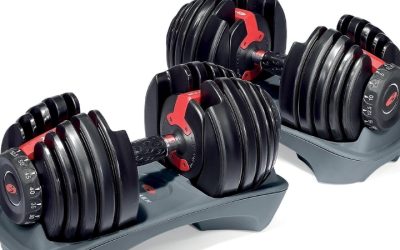
Best First Adjustable: FDB2 Set with Storage Box
Multiple weight settings with a storage box included is the most sensible first serious purchase for most people. You get a light setting for shoulders and a heavier one for presses and rows without owning four separate objects.
The ceiling is moderate, so lower-body work will eventually feel easy. That is a fair trade for a first set, but be aware you are buying a starting point rather than a permanent solution.
Easiest to Understand: 4-in-1 Free Weight Set
Four clearly defined configurations from 20 up to 90 lb, with very little to assemble incorrectly. For someone who wants to lift rather than fiddle, that clarity has real value in the first months.
The spacing between settings is wide. Jumping from 45 to 70 lb is far too much for a beginner’s press, so in practice you will use two of the four configurations for a long time.
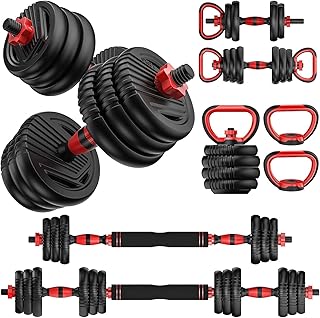
Best for Steady Progress: FITPLAM 5-in-1 Adjustable Set
Six loads at 20, 35, 45, 55, 70 and 90 lb give a beginner somewhere to go for years. The 10 and 15 lb steps in the middle are small enough that you can add weight without your form falling apart, which is the actual definition of good progression.
There are more plates and collars to manage than a simpler set, and the nut needs a proper hand-tighten each time. Neither is difficult, but both are new habits to learn alongside the lifting itself.
Best to Grow Into: 5-in-1 Connector Dumbbell Set
The connector bar means this set stays relevant long after a beginner phase, adding barbell rows, floor presses and hip thrusts up to 90 lb once you are ready for them.
For a genuine novice it is more equipment than the moment requires. The setup time and the number of components make it a better second purchase than a first one.
Best if You Are Certain: CAP Hex Set with Rack
If you already know you will train for years and have a spare corner, buying fixed pairs on a rack skips the entire upgrade cycle. Nothing to adjust, nothing to fail, and the rubber coating keeps floors and noise under control.
It is a large commitment for someone in their first month. The increments you choose are the increments you own, and a beginner rarely knows yet which pairs they will actually live in.
Frequently Asked Questions
What dumbbell weight should a beginner start with?
Most people start around 5 to 10 lb per hand for shoulder work and 15 to 25 lb for presses, curls and rows. Legs need considerably more, which is the main reason a single fixed pair is rarely enough.
How often should I increase the weight?
When you can complete every prescribed rep with two clean reps left in reserve, add the next increment. For beginners that often happens every two to three weeks on upper body and faster on legs.
Do I need different weights for arms and legs?
Almost certainly. Lower body and back handle two to three times what shoulders can manage, so any set covering only one narrow band will leave half your routine either impossible or pointless.
Is it normal to feel sore for days after starting?
Yes in the first couple of weeks, and it fades as your body adapts. Sharp joint pain during a lift is a different signal entirely and means the weight or the technique needs adjusting.
Final Thoughts
Most beginners are best served by the FDB2 Set with Storage Box, which covers a full routine without overwhelming anyone in their first month. If you already know you intend to keep training, the FITPLAM 5-in-1 Adjustable Set is the smarter buy because its 90 lb ceiling and closer increments will still be useful in three years.
Write Your Review
No reviews yet. Be the first to share your experience!