
Key takeaways
- Insist on removable weight, not a fixed block. A sealed 10 lb cuff gives you exactly one setting. Insert-based cuffs let you run 6 lb on a movement you’re new to and 10 lb on one you’ve owned for months. Progressive overload requires increments, and increments require parts you can take out.
- Check the strap length against your actual ankle, not an average one. If you train in high-top shoes or have thicker calves, a cuff that only just closes will slide down mid-set. Look for generous hook-and-loop overlap — the extra inches are what keep the weight from migrating during a 15-rep curl.
- Decide whether you want them for lifting or for walking. Strapping weight on for daily errands loads your knees and hips through thousands of unmonitored reps and changes your gait. Using them for a defined set of 12 hamstring curls does not. Buy them as training equipment and treat them that way.
- Match total weight to the weakest exercise you’ll use them on. Hip abduction lying on your side is brutally hard with 8 lb. Weighted step-ups barely notice it. Pick a range where your hardest planned movement is challenging at the low setting, and your easiest is challenging at the high setting.
- Look at the shell and the filler. Sand-filled cuffs with a tight stitched shell and a nylon exterior survive being dropped on concrete. Cheap versions leak from the seams within a few months, and once they start shedding filler the weight becomes uneven between the pair.
What's inside
A dumbbell leg day lives or dies on one detail: whether you can actually load the muscle before your grip, your lower back, or your patience gives out. That’s the honest limitation of training legs with dumbbells. Your quads and glutes are the strongest tissue you own, and a pair of 35s in your hands stops being a challenge for them long before it stops being awkward to hold. Goblet squats turn into a wrist endurance test. Romanian deadlifts start feeling like a shrug. Split squats work beautifully for about three weeks, then plateau because you can’t add weight without the dumbbells banging into your shins.
The fix isn’t always a heavier dumbbell. Often it’s redistributing where the load sits. Strap resistance to your ankles and suddenly leg curls, standing kickbacks, hip abduction, and step-throughs become progressive movements instead of warmup theater — and every single-leg exercise gets a second life because the weight is now below the knee, where the lever arm does the work for you. Below I’ve broken down the one piece of gear that solves this specific problem, how to judge whether it fits your training, and the mistakes that make ankle weights useless for most people who buy them.
As an Amazon Associate we earn from qualifying purchases at no extra cost to you. Product prices and availability are accurate as of the date shown and are subject to change.


#2 Pick

#3 Pick
#4 Pick

#5 Pick

#6 Pick

#7 Pick

Quick Comparison
| Product | Weight Range | Adjustability | Best Use | Worth It For |
|---|---|---|---|---|
| CAP Barbell Adjustable Ankle Weights (10–20 lb Pair, Black) | 5–10 lb per ankle, 20 lb total | Removable weighted inserts, incremental loading | Hamstring curls, glute kickbacks, abduction, weighted step-ups, hanging leg raises | Home lifters who’ve outgrown bodyweight single-leg work and want progression without buying heavier dumbbells |
How to Choose
- Insist on removable weight, not a fixed block. A sealed 10 lb cuff gives you exactly one setting. Insert-based cuffs let you run 6 lb on a movement you’re new to and 10 lb on one you’ve owned for months. Progressive overload requires increments, and increments require parts you can take out.
- Check the strap length against your actual ankle, not an average one. If you train in high-top shoes or have thicker calves, a cuff that only just closes will slide down mid-set. Look for generous hook-and-loop overlap — the extra inches are what keep the weight from migrating during a 15-rep curl.
- Decide whether you want them for lifting or for walking. Strapping weight on for daily errands loads your knees and hips through thousands of unmonitored reps and changes your gait. Using them for a defined set of 12 hamstring curls does not. Buy them as training equipment and treat them that way.
- Match total weight to the weakest exercise you’ll use them on. Hip abduction lying on your side is brutally hard with 8 lb. Weighted step-ups barely notice it. Pick a range where your hardest planned movement is challenging at the low setting, and your easiest is challenging at the high setting.
- Look at the shell and the filler. Sand-filled cuffs with a tight stitched shell and a nylon exterior survive being dropped on concrete. Cheap versions leak from the seams within a few months, and once they start shedding filler the weight becomes uneven between the pair.
Top Picks Reviewed
CAP Barbell Adjustable Ankle Weights | 10-20 lb Pair | Black
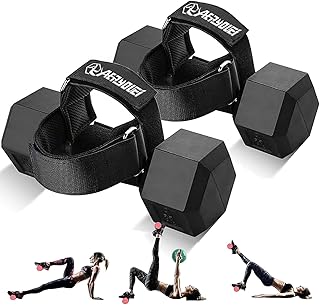
This is a straightforward, unglamorous piece of equipment, and that’s exactly the point. Each cuff holds removable weighted inserts, so you’re working with a range rather than a single number — pull two out for lying hamstring curls where 10 lb per leg would wreck your form, load them all back in for cable-free glute kickbacks and standing abduction. The full pair tops out at 20 lb combined, which is the sweet spot for below-the-knee loading. Any heavier and the cuff starts fighting your ankle joint instead of your muscle.
Where these earn their place in a dumbbell-based leg routine is on the movements dumbbells handle badly. Hamstring isolation is the obvious one: without a machine, prone leg curls with a dumbbell squeezed between your feet is a clumsy, unstable mess, and the weight tends to slip at the exact moment you’re near failure. Cuffs eliminate that entirely. Glute-focused work also opens up — quadruped kickbacks, standing hip extensions, and fire hydrants all become loadable instead of endless. And on Bulgarian split squats or reverse lunges, adding 5 lb to each ankle raises the demand without changing anything about your grip or torso position.
The build is basic in a good way: soft-lined nylon shells, wide hook-and-loop closures with real overlap, and a black finish that doesn’t advertise itself. The straps hold through explosive reps as long as you cinch them above the ankle bone rather than over the joint. Two practical notes. First, they’re bulkier than they look, so if you wear them over shoes on step-ups, expect some contact between cuffs on narrow stances. Second, verify both cuffs are loaded identically before you start — it’s easy to lose track of inserts, and an uneven pair will quietly bias one side over weeks of training. Neither is a flaw, just something worth knowing before your first session.
Frequently Asked Questions
Will ankle weights actually build muscle, or just add cardio difficulty?
They build muscle when you use them for sets and reps to near failure, the same as any load. Twelve controlled hamstring curls with 8 lb on the ankle is a legitimate hypertrophy stimulus for a muscle that gets little direct work in a dumbbell routine. What doesn’t build muscle is wearing them casually — that’s low-grade, unstructured loading with no progression.
How do I program these alongside my dumbbell exercises?
Use dumbbells for your compound work — squats, RDLs, lunges, step-ups — and bring in the cuffs for accessories at the end. Two or three sets of hamstring curls, two sets of abduction, two sets of glute kickbacks, all in the 12–20 rep range. Roughly ten to fifteen minutes of extra work covering exactly what heavy dumbbell movements miss.
Are they hard on your knees?
Not during deliberate strength work, where the joint moves through a controlled range under moderate load. The risk comes from prolonged wear during walking or running, which repeatedly loads the knee in extension with a long lever. Put them on for your sets, take them off after.
Should I start at the lowest weight setting?
Yes, especially for hip abduction and prone hamstring curls, which feel far heavier than the number suggests. Start light, confirm the strap position holds without sliding, then add an insert per side once you’re finishing your target reps with two or three left in the tank.
Final Thoughts
Dumbbells will take your legs a long way, but they leave gaps — direct hamstring work, loaded glute isolation, and progression on single-leg movements once the weight in your hands becomes the limiting factor. A pair of adjustable ankle cuffs closes those gaps for a fraction of what another set of heavy dumbbells costs, and they take up drawer space instead of floor space. Load them incrementally, use them for defined sets rather than all-day wear, and they’ll quietly become the reason your leg day keeps producing results instead of stalling out.

Write Your Review
No reviews yet. Be the first to share your experience!