
Key takeaways
- Check how the head attaches to the handle. On quality hex dumbbells the handle is a single piece running through the head, mechanically locked and then rubber-encased. Cheap ones bond a head to a stub. If a listing won’t tell you, assume the worse method.
- Decide whether you’ll ever drop them. Heavy pressing, single-arm rows to failure, and anything overhead means weights hit the floor eventually. Rubber-coated iron shrugs it off; molded plastic housings and dial mechanisms do not.
- Count the increments you actually need. Upper-body pressing stalls without 5 lb jumps in the 20–50 lb range. A five-pair fixed set with 10 lb gaps looks cheap until you’re stuck between two weights for a month.
- Measure the handle diameter and knurl. Anything under about 30 mm feels thin in heavy rows; smooth chrome handles turn slick the moment your palms sweat. Mild knurling is the sweet spot for bare hands.
- Look for sold parts, not just a warranty. A company that lists replacement end caps, selector pins, or cradles will keep your set alive for a decade. A warranty that ships you an entire new dumbbell is a coin flip on freight damage.
What's inside
Dumbbells don’t wear out gradually; they fail at a seam. The rubber head shears loose from the handle and starts spinning a quarter turn on every rep. An end cap backs out and drops a washer under your bench. On adjustables, the selector pin rounds off, or the plastic sleeve that holds a plate cracks after one landing on a concrete slab. Nearly every complaint about home-gym dumbbells traces back to one of those four points, which means durability isn’t a vague quality — it’s a question of how a specific manufacturer joined metal to metal, or metal to plastic.
So that’s the lens here. Six dumbbells, each scored out of 10 for durability based on construction method, the known failure points of that design, replacement-part availability, and how much abuse the format tolerates before it stops feeling safe. Fixed hex sets score higher almost by default — fewer moving parts, fewer things to break — but they also cost more per pound of usable weight and eat floor space. The adjustables earn their place by solving a real problem, and I’ve noted exactly where each one is fragile rather than pretending it isn’t.
As an Amazon Associate we earn from qualifying purchases at no extra cost to you. Product prices and availability are accurate as of the date shown and are subject to change.


As an Amazon Associate we earn from qualifying purchases at no extra cost to you. Product prices and availability are accurate as of the date shown and are subject to change.
Quick Comparison
| Pick | Type | Weight Range | Durability Score | Best For |
|---|---|---|---|---|
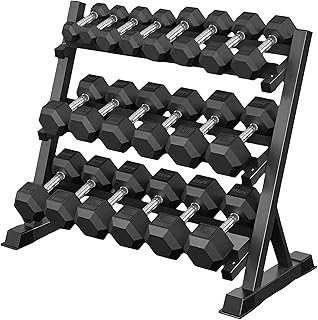
| Rogue Rubber Hex Dumbbells | Fixed hex | 5–125 lb pairs | 9.5/10 | Buy-once garage gyms |
| REP Fitness Rubber Hex Dumbbells | Fixed hex | 2.5–125 lb pairs | 9/10 | Building a full rack affordably |
| CAP Barbell Cast Iron Hex | Fixed hex, bare iron | 5–120 lb singles | 8.5/10 | Budget builds, no rubber odor |
| NÜOBELL 80LB Adjustable | Adjustable, twist-handle | 5–80 lb each | 7.5/10 | Serious lifting in a small room |
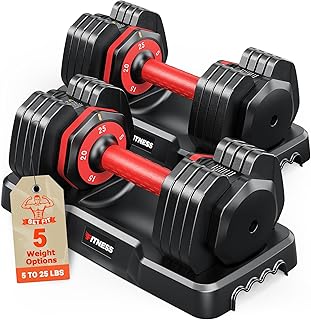
| PowerBlock Elite EXP | Adjustable, selector pin | 5–50 lb, expandable | 8/10 | Lifters who drop weights |
| Bowflex SelectTech 552 | Adjustable, dial | 5–52.5 lb each | 6.5/10 | General fitness and apartments |
How to Choose
- Check how the head attaches to the handle. On quality hex dumbbells the handle is a single piece running through the head, mechanically locked and then rubber-encased. Cheap ones bond a head to a stub. If a listing won’t tell you, assume the worse method.
- Decide whether you’ll ever drop them. Heavy pressing, single-arm rows to failure, and anything overhead means weights hit the floor eventually. Rubber-coated iron shrugs it off; molded plastic housings and dial mechanisms do not.
- Count the increments you actually need. Upper-body pressing stalls without 5 lb jumps in the 20–50 lb range. A five-pair fixed set with 10 lb gaps looks cheap until you’re stuck between two weights for a month.
- Measure the handle diameter and knurl. Anything under about 30 mm feels thin in heavy rows; smooth chrome handles turn slick the moment your palms sweat. Mild knurling is the sweet spot for bare hands.
- Look for sold parts, not just a warranty. A company that lists replacement end caps, selector pins, or cradles will keep your set alive for a decade. A warranty that ships you an entire new dumbbell is a coin flip on freight damage.
Top Picks Reviewed
Rogue Rubber Hex Dumbbells — Best Overall Durability
These are the closest thing to a permanent purchase in the category. The handle is machined steel with a medium knurl and a zinc finish, pressed through virgin rubber heads that are dense enough to thud rather than bounce when they land. What earns the top score is the absence of a weak joint: there’s no glued cap, no threaded collar, nothing to loosen over years of being racked hard. The trade-off is honest — you buy them in pairs, the price per pound is the highest here, and a full 5-to-50 ladder needs a rack and roughly six feet of wall. If you already know dumbbells are central to your training, this is where the money stops leaking.
REP Fitness Rubber Hex Dumbbells — Best Value in Fixed Weights
REP’s hex line uses the same fundamental construction as the premium option — through-handle, rubber-encased head — with a slightly contoured handle that fills the palm well on heavy pressing. Rubber odor is noticeable for the first couple of weeks and then fades. The reason to choose these is arithmetic: because they start at 2.5 lb and scale to 125, you can build a complete ladder for meaningfully less than the top pick, which usually means you buy the middle weights you’d otherwise skip. Finish quality on the handles is a touch behind Rogue’s, and that’s the entire gap.
CAP Barbell Cast Iron Hex — Best Budget Pick
Bare cast iron with a baked enamel coat has one enormous durability advantage: there’s no rubber to delaminate and no coating that matters if it chips. These are solid, single-piece castings, and a chipped edge is cosmetic rather than structural. They’re also sold as singles, so you can fill gaps in an existing set cheaply. What you give up is floor protection and grip comfort — the enamel handles are slick when wet, the hex corners will mark hardwood, and the raw iron will develop surface rust in a humid basement unless you wipe it down. Chalk and a rubber mat solve most of it.
NÜOBELL 80LB Adjustable Dumbbell — Best Heavy Adjustable
The twist-handle mechanism is the fastest genuinely useful adjustment I’ve used: rotate the handle in the cradle, lift, and you’re in a new weight in about two seconds, which makes drop sets practical. Plates are steel rather than molded composite, and the housing is compact enough that the dumbbell doesn’t feel like a barbell in your hand. It reaches 80 lb per side in 5 lb steps, which covers most home pressing and rowing indefinitely. The caveats are real: it must be returned to its cradle to change weight, the mechanism dislikes being dropped, and the plastic shell around the handle is the part that eventually cracks if you’re careless.
PowerBlock Elite EXP — Most Abuse-Tolerant Adjustable
PowerBlock’s rectangular cage looks strange and behaves better than it looks. The load sits around your hand instead of at the ends, the steel plates nest inside a welded frame, and a dropped PowerBlock tends to land flat and survive — the single biggest reliability advantage among adjustables. Selection uses a magnetic pin plus an internal adder for 2.5 lb steps, and the base expands from 50 to 70 and then 90 lb per hand with kits, so the platform grows instead of being replaced. Downsides: the cage restricts your wrist angle on curls and some pressing positions, and pin selection is slower than a twist dial.
Bowflex SelectTech 552 — Best for General Fitness
The dial system remains the most intuitive on the market, and the 2.5 lb increments up to 25 lb make it genuinely good for accessory and rehab work where small jumps matter. It replaces fifteen pairs in the footprint of one, which is the whole point in an apartment. It’s also the most fragile pick, hence the lowest score: the plates are molded resin over metal, the dial indexes into plastic teeth, and dropping one from lockout is a realistic way to end its life. Treat it as a tool for controlled reps rather than max-effort work and it will last years; use it for heavy floor presses and it won’t.
Frequently Asked Questions
Are adjustable dumbbells safe for heavy lifting?
The mechanisms themselves are safe when the weight is properly seated — the risk is user error. Always confirm the plates are locked by lifting the dumbbell an inch and giving it a small shake before it goes overhead. Above roughly 60 lb per hand, I’d rather be holding a fixed hex, mostly because a fixed dumbbell has no state to verify.
How much weight range do I actually need at home?
For most people training for strength and general fitness, 5 to 50 lb per hand covers years of progress, with rows and heavy presses being the first movements to outgrow it. If you’re already pressing 60s at a commercial gym, buy to 80 or plan an expandable platform now rather than paying twice.
Do rubber dumbbells damage floors, and do I still need a mat?
Rubber heads protect finished floors from chips but not from the point load of a 90 lb dumbbell landing on one corner — on wood or laminate that can still dent the subfloor. A 3/4-inch stall mat or a pair of horse-stall pads under your training area handles both impact and noise, and it’s the cheapest insurance in the gym.
Is it worth buying a full fixed set instead of adjustables?
It’s worth it when three things are true: you have wall space for a rack, you train dumbbell movements at least twice a week, and you value zero setup time between sets. Otherwise adjustables win on cost per pound and floor space, and the durability gap matters less than the space you don’t have.
Final Thoughts
If the budget allows and the room exists, a fixed rubber hex ladder is the last dumbbell purchase you’ll make — Rogue if you want the strongest construction, REP if you’d rather spend the difference on more weights, and cast iron singles to plug gaps for very little money. If space is the binding constraint, choose your adjustable by how you train rather than by the spec sheet: the twist-handle design for fast, heavy sets in a dedicated room, the cage-style block if your weights ever hit the floor, and the dial system if you want small increments and painless setup for general fitness work. Match the format to your actual habits and durability mostly takes care of itself.
FAQ
Are adjustable dumbbells safe for heavy lifting?
How much weight range do I actually need at home?
Do rubber dumbbells damage floors, and do I still need a mat?
Is it worth buying a full fixed set instead of adjustables?
Best Ab Workouts with Dumbbells: 6 Support Picks Compared
Best ab workouts with dumbbells are limited more often by position than...
Best Budget Adjustable Dumbbell: 6 Picks and Trade-Offs
Best budget adjustable dumbbell shopping is really a question about what you...
Best Abs Exercise with Dumbbells: 6 Picks by Coating Type
Best abs exercise with dumbbells movements rest the weight against your chest,...
Best Abs Workout with Dumbbells: 6 Picks for Fast Circuits
Best abs workout with dumbbells formats are almost always circuits, and circuits...
Best at Home Dumbbells: 6 Picks for Sharing a Household
Best at home dumbbells guides assume one user. Most households have two,...
Best Dumbbells Home Gyms Use: 6 Picks Ranked by Delivery
Best dumbbells home buyers compare weight ranges and then discover the real...
Best Ab Exercise with Dumbbells: 6 Floor-Friendly Picks
Best ab exercise with dumbbells options are mostly done lying down, which...
Best Dumbbell Set for Home Gym: 5 Picks Ranked by Space
Best dumbbell set for home gym shopping starts with a definition problem....
Best Workout for Forearms with Dumbbells: 5 Gear Choices
Best workout for forearms with dumbbells depends less on the exercise list...
Best Lat Exercises Dumbbells: 6 Picks for Heavy Row Work
Best lat exercises dumbbells face a problem arm work never does: the...
Write Your Review
No reviews yet. Be the first to share your experience!