
Key takeaways
- Measure the lowest obstruction, not the ceiling. Ductwork, sprinkler heads, garage door tracks, and light fixtures all count. If a garage door opens overhead, check clearance with the door fully retracted, not closed.
- Decide whether you want an angled or vertical rail. A 5–10 degree angled path tracks closer to a natural bench press groove and feels less pinched at the shoulder. Vertical rails are simpler, cheaper, and shorter — which is often the whole point in a low room.
- Check the bar’s bottom stop. Some machines can’t bring the bar to chest height on a thick bench, or can’t get low enough for deep squats. Look for a rail with plenty of usable travel and adjustable safety stops at close intervals, ideally every inch or two.
- Account for plate clearance and walkaround space. A 45-pound plate adds roughly 9 inches per side beyond the sleeve. Add 24 to 30 inches of walking room on at least one side, or you’ll be loading plates while straddling a bench.
- Match the frame to how much you’ll ask of it. Look for 11- or 12-gauge steel with a 2″x2″ or larger tube if you plan to load heavy or add attachments later. Lighter 14-gauge frames are fine for moderate weights but flex noticeably once you’re pressing over a couple hundred pounds.
The measurement that kills most home Smith machine plans isn’t the footprint — it’s the ceiling. A Smith bar rides a fixed rail, and that rail has to clear your pressing lockout plus a few inches of overtravel, plus whatever the frame’s top crossmember eats. Basement with 7-foot joists and a duct run down the middle? A vertical-rail machine will hand you a bar that stops at forehead height. Garage with 9 feet of clear span but a car that has to fit back in at night? Now footprint and folding matter more than height. Before you shop, get a tape measure and write down four numbers: clear ceiling height at the machine’s spot, lowest obstruction anywhere in the bar’s path, floor length, and floor width including the space you need to walk around a loaded bar.
The picks below are sorted by the room they actually fit, not by brand prestige. I’ve grouped them into three practical buckets: low-ceiling rooms under about 7’6″, standard 8-foot rooms, and open garage or outbuilding spaces where you can afford a full rack-and-Smith combo. Specs vary by production run, so treat every dimension here as a starting point and confirm against the current manufacturer sheet before you buy — a two-inch discrepancy is the difference between a working press and an expensive coat rack.
As an Amazon Associate we earn from qualifying purchases at no extra cost to you. Product prices and availability are accurate as of the date shown and are subject to change.

#1 Pick

#2 Pick

#3 Pick
#4 Pick

#5 Pick

#6 Pick

#7 Pick

As an Amazon Associate we earn from qualifying purchases at no extra cost to you. Product prices and availability are accurate as of the date shown and are subject to change.
#1 Pick
Quick Comparison
| Machine | Approx. Footprint | Ceiling Needed | Bar Path | Best Room |
|---|---|---|---|---|
| Valor Fitness BE-11 | ~50″ W x 50″ D | ~7’0″ | Vertical, low-profile top | Low basements, spare bedrooms |
| Marcy MD-9010G Smith Cage | ~80″ W x 65″ D | ~7’2″ | Vertical with cable stack | Wide but short rooms |
| Titan Plate-Loaded Smith Machine | ~55″ W x 60″ D | ~7’6″ | Vertical, bushing-guided | Budget builds, single-purpose corners |
| Body-Solid GS348Q Series 7 | ~53″ W x 79″ D | ~8’0″ | 7-degree angled rail | Standard-height dedicated gym rooms |
| Force USA G3 All-In-One | ~48″ W x 68″ D | ~7’6″ | Angled Smith + cables | Small rooms needing everything |
| Force USA G20 Pro | ~70″ W x 76″ D | ~8’6″ | Angled Smith + dual pulleys | Garages, basements with clear span |
How to Choose
- Measure the lowest obstruction, not the ceiling. Ductwork, sprinkler heads, garage door tracks, and light fixtures all count. If a garage door opens overhead, check clearance with the door fully retracted, not closed.
- Decide whether you want an angled or vertical rail. A 5–10 degree angled path tracks closer to a natural bench press groove and feels less pinched at the shoulder. Vertical rails are simpler, cheaper, and shorter — which is often the whole point in a low room.
- Check the bar’s bottom stop. Some machines can’t bring the bar to chest height on a thick bench, or can’t get low enough for deep squats. Look for a rail with plenty of usable travel and adjustable safety stops at close intervals, ideally every inch or two.
- Account for plate clearance and walkaround space. A 45-pound plate adds roughly 9 inches per side beyond the sleeve. Add 24 to 30 inches of walking room on at least one side, or you’ll be loading plates while straddling a bench.
- Match the frame to how much you’ll ask of it. Look for 11- or 12-gauge steel with a 2″x2″ or larger tube if you plan to load heavy or add attachments later. Lighter 14-gauge frames are fine for moderate weights but flex noticeably once you’re pressing over a couple hundred pounds.
Top Picks Reviewed
Valor Fitness BE-11 — Best for Ceilings Under 7’6″
The BE-11’s appeal is almost entirely geometric: a short, squat frame with a vertical rail and minimal structure above the top of the bar’s travel. That makes it one of the few Smith machines that genuinely works in a finished basement with joists at 7 feet. The tradeoff is a straight bar path and modest capacity, so it’s better suited to controlled hypertrophy work than maximal singles. Pair it with an adjustable bench and it covers press, squat, shrug, and calf raise without dominating the room.
Marcy MD-9010G Smith Cage Home Gym — Best Low-Ceiling All-Rounder
This one trades height for width. It sprawls sideways with an integrated cable stack, pec station, and pull-down, which means it needs a wide wall but very little vertical room. It’s the practical choice for a garage bay or long basement wall where you want a full circuit in one purchase. Don’t expect powerlifting-grade rigidity — the value here is exercise variety per dollar and per inch of headroom.
Titan Plate-Loaded Smith Machine — Best Budget Single-Purpose Unit
Straightforward, heavy, cheap. The Titan is a bare Smith machine with a vertical rail, weight storage pegs, and no pretensions of being a cable gym. If you already own a bench and plates and just want guided pressing and squatting in a corner, this is the least complicated route. Assembly is the usual bolt-together marathon, and I’d budget an afternoon plus a second set of hands for the uprights.
Body-Solid GS348Q Series 7 — Best Angled Bar Path
The Series 7 uses an angled rail with linear bearings, and the difference is obvious the first time you bench on it: the bar drifts toward your chest on the descent instead of forcing a vertical groove. It’s a deep machine, so measure front-to-back carefully, and it wants a true 8-foot ceiling. For a dedicated gym room where the Smith machine is the centerpiece, it’s the most refined pressing feel of this group.
Force USA G3 All-In-One Trainer — Best Small-Room Combo
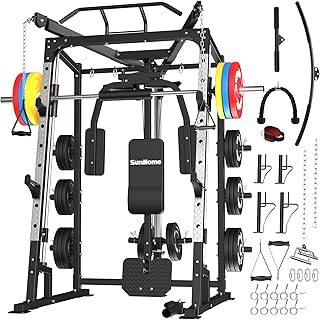
The G3 packs a Smith rail, a power rack, a single pulley column, and a chin bar into a footprint roughly the size of a loveseat. It’s a compromise machine by design — the cable stack is smaller than a dedicated functional trainer’s and swapping between modes takes a minute — but nothing else fits this much capability into a spare bedroom. Its angled Smith rail is a real advantage over the budget vertical units.
Force USA G20 Pro — Best for Garages and Open Basements
If you have clear span and 8’6″ or more, the G20 Pro is the ceiling of the category: angled Smith, dual weight-stack pulleys, a proper rack with safeties, leg press and lat attachments available. It’s heavy, expensive, and needs real assembly time, but it replaces four separate machines. Confirm your garage door clearance and slab levelness before ordering — this is not
Best Robot Vacuum with Self Emptying Station for Pet Hair in 2026: Tested and Ranked
Living with furry companions brings immense joy, but dealing with relentless shedding...
Best Gym Mat for Home: Rubber vs Foam Picks for Any Floor
Best gym mat for home choices come down to material density and...
Best Rowers for Home Gym: Air, Magnetic and Water Compared
Best rowers for home gym shortlists usually collapse once someone measures the...
Best Weight Home Gym: 6 All-in-One Machines for Small Rooms
Best weight home gym decisions come down to two numbers before brand...
Best Home Gym Equipment for Beginners: The Starter Setup
Best home gym equipment for beginners is not a machine – it...
Best Treadmills for Home Gym: 5 Picks by Deck and Motor
Best treadmills for home gym decisions come down to two specifications and...
Best Home Gym Compact Setups: 6 Space-Saving Picks Ranked
Best home gym compact claims usually quote a stored footprint and stay...
Best Adjustable Bench for Home Gym: 5 Picks Ranked by Use
Best adjustable bench for home gym decisions turn on three numbers most...
Best Cable Machine for Home Gym: 5 Picks and Pulley Ratios
Best cable machine for home gym shortlists collapse quickly once you convert...
Best Cable Machines for Home Gym: 5 Types and Their Limits
Best cable machines for home gym use are not one product category...
Write Your Review
No reviews yet. Be the first to share your experience!