Key takeaways
- The best Loloi Magnolia Home designer area rugs depend on whether you prioritize vintage pattern, easy cleaning, a low profile for doors, or a softer feel underfoot: choose a washable or low-pile synthetic rug for busy family rooms, a distressed…
The best Loloi Magnolia Home designer area rugs depend on whether you prioritize vintage pattern, easy cleaning, a low profile for doors, or a softer feel underfoot: choose a washable or low-pile synthetic rug for busy family rooms, a distressed traditional pattern for layered farmhouse decor, and a wool or wool-blend design when texture and longevity matter most.
Best Loloi Magnolia Home Rugs by Decorating Situation
| Need | Best rug direction | Why it works | Watch for |
|---|---|---|---|
| Small apartment or dining nook | 5 x 7 or 6 x 9 ft low-pile rug | Fits beneath a compact seating group without crowding walkways | Leave at least 18–24 inches of exposed floor around the rug where possible |
| Family room with children or pets | Distressed, low-pile synthetic design | Pattern disguises small marks and the short surface is easier to vacuum | Check whether the exact style is machine washable before buying |
| Traditional or farmhouse room | Vintage Persian-inspired pattern in muted neutrals | Adds color variation without competing with wood furniture or architectural details | Highly detailed patterns can look busy in a small room |
| Bedroom or reading corner | Medium-pile or textured wool-blend rug | Feels warmer and more comfortable beside a bed or lounge chair | Natural fibers may shed initially and usually need gentler care |
| Rental with doors that swing inward | Flatweave or low-pile rug under 0.25 inch | Reduces interference with doors and robot vacuums | Use a rug pad to prevent shifting and improve cushioning |
How the Main Magnolia Home Rug Looks Compare
Vintage Persian-inspired patterns
These are the safest choice when you want the recognizable Magnolia Home look: faded medallions, floral borders, washed reds, taupes, indigo, ivory, and soft gray. The variation in color makes them more forgiving than a solid rug. They suit farmhouse, transitional, cottage, and traditional rooms, especially when paired with natural wood, linen upholstery, and aged metal.
A vintage pattern is also practical in a high-traffic room because minor crumbs, paw marks, and everyday dulling are less visible. The trade-off is visual density. In a 10 x 12 foot room with a patterned sofa, curtains, and multiple framed artworks, choose a design with a larger central field and fewer contrasting colors.
Faded floral and botanical designs
Floral patterns bring softness to bedrooms, nurseries, and sitting rooms. They work particularly well when the surrounding furniture is simple: a plain upholstered bed, painted dresser, or neutral sofa gives the rug room to act as the decorative focal point.
For a restrained look, select a rug whose background is close to the floor color and whose floral motifs differ by only one or two shades. If you want the rug to define the room, choose stronger rust, blue, sage, or charcoal accents—but repeat at least one of those colors in cushions, artwork, or curtains.
Abstract and globally influenced patterns
Less traditional designs are useful in modern farmhouse, relaxed contemporary, and eclectic interiors. Their irregular lines can bridge clean-lined furniture and older architectural features. They are usually easier to coordinate than a formal medallion when your room already contains geometric elements such as slatted doors, grid windows, or a patterned accent chair.
These patterns vary considerably across Magnolia Home by Loloi collections and individual colorways, so look at the full-size product image rather than relying only on the collection name. A pale abstract rug may appear almost solid from across the room, while a darker colorway can have much stronger contrast.
Materials, Pile Height, and Cleaning Trade-Offs
| Construction or material | Typical feel | Advantages | Limitations | Best use |
|---|---|---|---|---|
| Polypropylene | Firm to moderately soft; often low pile | Good stain resistance, practical price, straightforward vacuuming | Less naturally plush than wool; heat can damage fibers | Dining rooms, entryways, play spaces |
| Polyester | Soft and smooth | Comfortable underfoot and commonly available in washable constructions | Can flatten in heavily trafficked paths; oily stains may be stubborn | Bedrooms and casual living rooms |
| Wool or wool blend | Springy, textured, and warmer | Durable fiber, naturally resilient, premium appearance | Higher cost, possible initial shedding, more care-sensitive | Formal living rooms and bedrooms |
| Flatweave | Very thin and firm | Door-friendly, easy to move, often simple to vacuum | Provides less cushioning and may slide without a pad | Dining areas, kitchens, and rentals |
| Low pile, approximately 0.15–0.35 inch | Short and even | Best balance of cleanability, furniture stability, and door clearance | Not as soft as a shag or thick plush rug | Most family rooms and high-traffic areas |
| Medium pile, approximately 0.4–0.6 inch | Noticeably cushioned | More comfortable for bare feet | Needs more thorough vacuuming and can catch beneath doors | Bedrooms and low-traffic sitting areas |
Exact fiber content and pile height can differ by Magnolia Home by Loloi rug, size, and collection. Confirm the individual specification before ordering, particularly if “washable” is essential. A rug described as easy-care is not automatically suitable for a washing machine.
Choosing the Correct Rug Size
Living room
For a standard seating arrangement, a 5 x 7 foot rug can work with only the front legs of a sofa and chairs on the rug. A 6 x 9 foot rug gives the arrangement more visual weight. In a 10 x 12 foot room, an 8 x 10 foot rug is often the most balanced option: place the sofa’s front legs on it and leave roughly 12–24 inches of floor between the rug edge and the walls.
For a larger room, an 8 x 10 or 9 x 12 foot rug lets all major seating sit fully on the rug. This is more stable and makes an open-plan room feel intentionally grouped, but it costs more and is harder to rotate or move.
Dining room
The rug should extend at least 24 inches beyond every side of the table so dining chairs remain on the rug when pulled out. For a 60-inch round table, a rug around 8 feet in diameter—or a square rug roughly 8 x 8 feet—usually gives adequate clearance. For a 72-inch rectangular table, an 8 x 10 foot rug is a common starting point.
Low pile is preferable under dining furniture. Chairs are less likely to catch, and crumbs are easier to remove. Avoid a thick pile if the table has narrow legs or if household members frequently pull chairs in and out.
Bedroom
For a queen bed, an 8 x 10 foot rug placed horizontally typically extends beyond both sides and reaches several feet beyond the footboard. A 6 x 9 foot rug can work when only the lower two-thirds of the bed sits on the rug. Runners measuring about 2.5 x 7 or 2.5 x 8 feet are useful on each side of the bed when a full-size rug will not fit.
What Makes These Rugs Easy—or Difficult—to Live With?
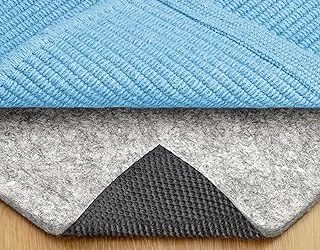
Low-pile synthetic rugs are generally the easiest choice for weekly maintenance. Vacuum slowly in both directions, use the manufacturer’s recommended setting, and treat spills by blotting rather than scrubbing. A rug pad reduces sliding, protects the floor, and limits wrinkling; choose one slightly smaller than the rug so it does not show at the edges.
Natural-fiber rugs bring better texture and resilience but need more patience. Wool may shed during the first several months, and aggressive brushing can pull fibers. Do not saturate a non-washable rug or assume that a washable label applies to every size. For serious stains, follow the care label or use a rug-cleaning professional familiar with the fiber.
Also plan for delivery and moving. An 8 x 10 foot rug can be awkward even when rolled, and a pad adds bulk. Measure the narrowest doorway, stair landing, and elevator opening—not just the room where the rug will go. Once in place, rotate the rug every few months if traffic is uneven; this helps prevent one walkway from wearing or flattening faster than the rest.
Final Buying Decision
Choose a distressed, low-pile polypropylene or polyester Magnolia Home by Loloi rug when durability, visible disguising of messes, and simple vacuuming matter most. Choose a floral design for a bedroom or softer sitting room, a muted Persian-inspired pattern for farmhouse and transitional interiors, and a low-contrast abstract design for modern rooms. If comfort and texture outrank price and maintenance, move toward wool or a wool blend.
Before purchasing, confirm the exact dimensions, fiber, pile height, backing, care instructions, and whether the listed size is machine washable. Then mark the intended footprint on the floor with painter’s tape. That simple step reveals whether the rug leaves enough clearance for doors, dining chairs, sofa legs, and walkways—often more reliably than a product photograph.