Key takeaways
- Sediment filtration: Captures particles such as sand, rust flakes, and pipe debris. It is particularly useful with older plumbing or well water.
- Activated carbon: Improves taste and odor and can reduce chlorine. Look for a stated contaminant-reduction claim rather than assuming every carbon cartridge removes the same substances.
- Carbon block or blended media: Often provides more consistent contact with water than loose carbon, but can restrict flow sooner as it loads up.
- Specialty media: Some cartridges target fluoride, chloramine, heavy metals, or scale. These claims need independent certification or a specific performance data sheet.
- Reverse osmosis pretreatment: RO can reduce many dissolved contaminants, but very low-mineral water may require remineralization before electrolysis and can increase waste-water and maintenance costs.
The best water ionizers are usually countertop models for renters and simpler installation, while under-sink systems are the better choice when you want a cleaner-looking setup, higher daily capacity, and less counter clutter—but neither type should be purchased for unproven disease-treatment claims.
Best water ionizers by situation
| Situation | Better choice | Why | Main compromise |
|---|---|---|---|
| Small apartment or rental | Countertop ionizer with diverter | Usually installs without drilling and can move with you | Uses counter space and may require a faucet adapter |
| Busy household using several gallons daily | Under-sink ionizer or filtered-ionizer combination | Cleaner access, better flow, and less filling or repositioning | More complex installation and harder filter access |
| Hard water or visible sediment | Ionizer preceded by sediment and carbon filtration | Protects the cell plates and improves taste | More cartridges and higher annual maintenance cost |
| Kids, pets, or frequent cooking | System with a dedicated filtered-water outlet | Reduces accidental use of highly acidic or alkaline settings | May require a faucet modification or second dispenser |
| Renter who cannot alter plumbing | Countertop model with a removable diverter | Typically leaves no permanent hole in the sink or counter | Compatibility depends on the faucet thread |
| Lowest long-term cost | Moderately priced countertop unit with common filters | Lower installation expense and easier cartridge replacement | Usually fewer plates, lower flow, and less automation |
Countertop versus under-sink ionizers
Countertop models
A countertop ionizer connects to the faucet through a diverter valve or receives water from a small inlet hose. Installation commonly takes 15–45 minutes if the faucet has a compatible removable aerator. You generally need about 6–10 inches of counter width, 10–14 inches of depth, and 14–18 inches of vertical clearance, although exact dimensions vary. Leave enough room behind the unit for tubing to bend without kinking.

IVYEL PL-MAX Under Sink Water Ionizer – Korean-Made Smart Touch Faucet System with 7 Solid Platinum-Titanium Plates, DARC Self-Cleaning & 5-Year Warranty
Included for 'Best Water Ionizers: Compare Features, Filtration, and Value' because the listing specifies DARC Self-Cleaning & 5-Year Warranty, details this guide uses to compare options.
View on Amazon
Tyent - Ace-13 Water Ionizer - Advanced Hydrogen Alkaline Water System - Adjustable pH Levels - Dual Ultra Filtration - Touch Screen Control - Turbo Power - Hydration & Wellness - Pure Drinking Water
Included for 'Best Water Ionizers: Compare Features, Filtration, and Value' because the listing specifies Ace-13 Water Ionizer and Advanced Hydrogen Alkaline Water System, details this guide uses to compare options.
View on Amazon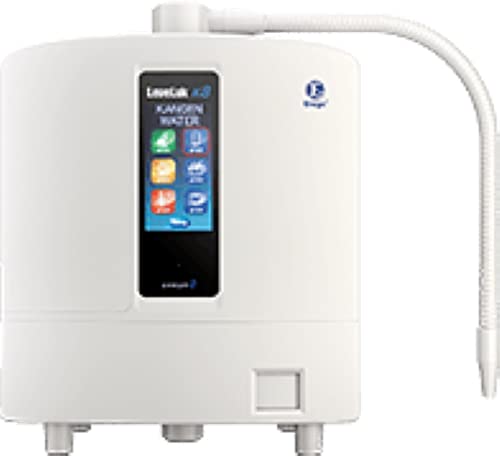
Enagic Leveluk K8 Water Filter Machine
Included for 'Best Water Ionizers: Compare Features, Filtration, and Value' as a relevant option in this category; details come from the product listing.
View on Amazon
Tyent Edge 9 Turbo Water Ionizer - Dual Filtration System-Hydrogen Enhanced Water Purification - Adjustable pH Settings with Turbo Mode - Touchscreen Interface & Auto-Flow Stop - Advanced Filtration
Included for 'Best Water Ionizers: Compare Features, Filtration, and Value' because the listing specifies Dual Filtration System-Hydrogen Enhanced Water Purification and Adjustable pH Settings with Turbo Mode, details this guide uses to compare options.
View on AmazonCountertop systems are the practical choice for renters, occasional users, and households that want to avoid a plumber. They are also easier to inspect when a filter leaks or a cleaning cycle is needed. The drawbacks are visible hoses, occupied counter space, and possible pressure loss when the faucet diverter is installed. A countertop unit may also need to be moved when cleaning the sink or using a large appliance nearby.
Under-sink models
An under-sink ionizer keeps the main body in the cabinet and dispenses treated water through a dedicated faucet or a modified combination faucet. Plan for approximately 10–15 inches of cabinet width, 15–20 inches of usable depth, and 18–24 inches of vertical clearance, including space to remove the filter housing. A garbage disposal, pull-out trash bin, or existing water filter can make the cabinet unsuitable even when the published dimensions appear to fit.
Under-sink installation often requires a shutoff-valve connection, drain routing, and a hole for a dedicated faucet. Some ionizers discharge acidic water during operation, so the drain connection must be secured and positioned according to the manufacturer’s instructions. A plumber is sensible when the shutoff valve is corroded, the cabinet has no spare faucet opening, or the system uses a more involved filtration or reverse-osmosis arrangement.
The major advantage is convenience: the faucet remains clear, the appliance is protected from splashes, and the system can supply a family without occupying the worktop. The trade-off is service access. A leaking cartridge or exhausted filter may go unnoticed under a crowded cabinet, and replacement parts can be more model-specific.
Filtration stages matter more than the number of pH settings
Most water ionizers use electrolysis rather than filtration to alter the water’s measured pH. Filtration and ionization are separate functions. A unit with seven pH selections is not automatically better than one with three if both receive the same incoming water and use comparable electrode technology.
- Sediment filtration: Captures particles such as sand, rust flakes, and pipe debris. It is particularly useful with older plumbing or well water.
- Activated carbon: Improves taste and odor and can reduce chlorine. Look for a stated contaminant-reduction claim rather than assuming every carbon cartridge removes the same substances.
- Carbon block or blended media: Often provides more consistent contact with water than loose carbon, but can restrict flow sooner as it loads up.
- Specialty media: Some cartridges target fluoride, chloramine, heavy metals, or scale. These claims need independent certification or a specific performance data sheet.
- Reverse osmosis pretreatment: RO can reduce many dissolved contaminants, but very low-mineral water may require remineralization before electrolysis and can increase waste-water and maintenance costs.
For municipal water, a single carbon stage may be adequate for taste and chlorine reduction if the local water report supports that choice. For private wells, test the water first. Ionizers are not a substitute for disinfection, arsenic treatment, nitrate treatment, or a properly maintained whole-home water system.
pH settings: useful control, limited meaning
Typical ionizers offer several selectable outputs, often ranging from mildly acidic to strongly alkaline on the manufacturer’s scale. The displayed pH is affected by source-water minerals, flow rate, temperature, electrode condition, and testing method. A setting shown as pH 9.5 on one water supply may not produce the same result on another.
For ordinary drinking water, a moderate setting is generally more practical than chasing the highest number. Strongly acidic output may be intended for cleaning or external use, while highly alkaline output can be unsuitable for some people and can alter the taste of coffee, tea, and delicate foods. Follow the product’s instructions and ask a clinician if you have kidney disease, take medicines affected by mineral intake, or have another condition that makes dietary changes relevant.
Alkaline water may temporarily affect the pH of stomach contents, but evidence does not establish that commercial ionizers prevent, treat, or cure cancer, diabetes, reflux, or other diseases. “Microbubbles,” “hydrogen-rich,” and “antioxidant” descriptions should not be treated as proof of a medical benefit. The strongest purchase case is usually improved taste, convenient filtration, and personal preference—not a health promise.
Head-to-head: established brands and what to compare
Enagic Leveluk K8: Enagic’s Kangen Water line is widely recognized and offers multiple output selections through a countertop format. Its strengths are brand availability and a mature support ecosystem. The main concern is value: purchase prices are often in the premium range, commonly above $3,000, while replacement filters and proprietary accessories add to ownership cost. Verify the exact model’s filtration claims and local service arrangements before buying.
Tyent UCE-series ionizers: Tyent sells countertop and under-counter-style water ionizers with multiple plates and automated cleaning features on selected models. These systems appeal to buyers wanting higher flow and extensive controls. Prices commonly fall around $2,000–$4,500 depending on configuration and seller. Confirm whether the model includes the filtration stage you need; a sophisticated electrode system does not replace sediment or contaminant-specific treatment.
AlkaViva models such as the Vesta: AlkaViva offers countertop ionizers with selectable settings and replaceable filtration. They are often positioned below the most expensive premium systems, with market prices commonly around $1,500–$3,000. Check cartridge availability, the expected gallon rating, and whether the installation kit fits your faucet before ordering.
| Cost factor | Countertop expectation | Under-sink expectation |
|---|---|---|
| Purchase price | Usually $500–$3,500 | Usually $1,000–$4,500 |
| Installation | Often $0–$150 if self-installed | Often $150–$600 with a plumber |
| Filter replacement | Commonly $50–$200 per cartridge | Commonly $75–$300 per cartridge or set |
| Typical replacement interval | About 6–12 months | About 6–12 months |
| Cleaning or descaling | Every few months in hard water | Every few months in hard water |
| Expected service life | Often 5–10 years with proper care | Often 5–10 years with proper care |
How to verify performance before buying
- Check the certification scope. Look for NSF/ANSI certification or another recognized independent certification for the specific contaminant and model, not just a general statement that the appliance is “certified.”
- Read the performance data sheet. Confirm the tested flow rate, cartridge capacity, inlet-water limits, and substances reduced.
- Compare your water report. Match the system to chlorine, chloramine, lead, nitrate, hardness, or other contaminants actually present in your supply.
- Ask how pH was measured. A pH number without the water’s mineral content, flow rate, and test method is difficult to compare.
- Calculate three-year cost. Add the unit, installation, filters, cleaning supplies, replacement hoses, and any required prefilter.
Maintenance realities that affect value
Hard water is the biggest durability issue for many ionizers. Mineral scale can reduce flow, change the measured output, and shorten the life of electrode plates. Automatic cleaning helps but does not eliminate descaling. Replace filters by time and capacity, whichever comes first, and do not wait for a bad taste if the cartridge has reached its rated limit.
Before choosing an under-sink model, measure the cabinet with doors and drawers fully open. For a countertop model, measure from the faucet outlet to the backsplash and keep at least 2 inches of clearance around ventilation openings. If you may move soon, a 15–25-pound countertop unit is easier to pack and reinstall than a permanently mounted system, though its box can still be awkward through a narrow doorway.
For most homes, the best water ionizer is the model whose filtration matches the water supply, whose replacement filters are readily available, and whose installation fits the room without daily inconvenience. Choose the highest pH range only if you have a clear, non-medical reason to use it; prioritize verified contaminant reduction, manageable maintenance, and total cost instead.