Key takeaways
- Compressor cooling: Usually provides colder water and recovers more effectively than thermoelectric cooling, but it is heavier and can make a low hum.
- Stainless-steel water paths: Often resist odors and staining better than inexpensive plastic components, although the external cabinet may still be plastic.
- Removable drip tray: A tray that lifts out easily is more important than a large-looking tray that cannot be washed properly.
- Mechanical or electronic controls: Simple push paddles are easy to operate and repair; touch panels look cleaner but add electronic complexity.
- Child lock: Essential on hot-water models. Check that it requires a deliberate two-step action rather than a light accidental touch.
- Filter access: A front or side-access filter is easier to replace than one hidden behind a permanently fixed panel.
The best water cooler dispenser depends on your water source, available floor space, and whether you value low refilling effort or simple installation: choose a bottleless unit for frequent use and predictable long-term costs, or a bottle-fed cooler for a rental, small household, or room without a nearby water line.
Best water cooler dispensers by situation
| Situation | Best choice | Why it fits | Plan for |
|---|---|---|---|
| Small apartment or home office | Bottom-loading bottle-fed dispenser | Does not need plumbing, and the bottle stays hidden in the cabinet | About 12–18 inches of side clearance and regular bottle deliveries |
| Busy family using several gallons daily | Point-of-use bottleless dispenser | Continuous supply without lifting heavy bottles | Water-line access, filtration changes, and installation |
| Renters | Top-loading or bottom-loading bottle-fed cooler | Portable and usually removable without modifying cabinetry | Storage for spare bottles and the weight of a full container |
| Children and pets | Bottom-loading model with child safety lock | Less lifting and a lower center of gravity than a top loader | Keep the drain tray clean and secure the unit against tipping |
| Someone with back or shoulder pain | Bottom-loading or bottleless model | Avoids lifting a full 3- or 5-gallon bottle overhead | Bottom cabinets still require bending or kneeling |
| Occasional use or emergency backup | Compact countertop dispenser | Uses little floor space and can sit near a sink or kitchenette | Lower dispensing speed and limited reservoir capacity |
Bottle-fed versus bottleless dispensers
Bottle-fed: easiest installation
A bottle-fed cooler draws water from a reusable bottle placed on top of the machine or inside a bottom cabinet. It is the practical choice when you cannot connect to a water line. Top-loading models are generally less expensive and have fewer moving parts. They are also easy to understand: when the bottle is empty, replace it.

Brio Bottom Loading Water Cooler Dispenser for 5 Gallon Bottles - 3 Temperatures with Hot, Room & Cold Spouts, Child Safety Lock, LED Display with Empty Bottle Alert, Stainless Steel
Included for 'Best Water Cooler Dispensers for Home and Office' because the listing specifies 3 Temperatures with Hot and Room & Cold Spouts, details this guide uses to compare options.
View on Amazon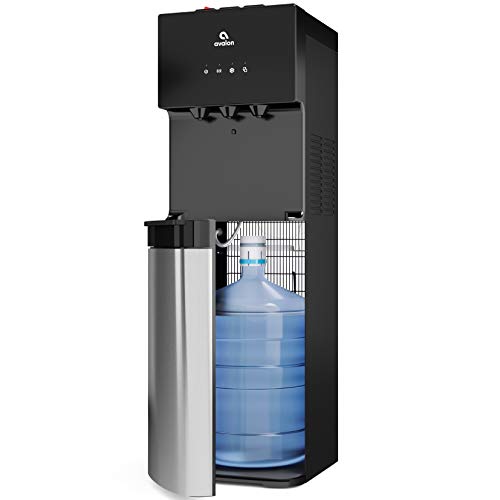
Avalon A4BLWTRCLR Bottom Loading Water Cooler Water Dispenser - 3 Temperature Settings - Hot, Cold & Room Water, Durable Stainless Steel Cabinet, Bottom Loading - UL/Energy Star Approved
Included for 'Best Water Cooler Dispensers for Home and Office' because the listing specifies 3 Temperature Settings and Hot, details this guide uses to compare options.
View on Amazon
Igloo Top Loading Water Cooler with Removable Drip Tray & Energy-Saving Features- Water Tower with Hot, Cold Temperature Settings- Water Dispenser Fits 3 & 5-Gallon Jugs with Child Safety Lock- Black
Included for 'Best Water Cooler Dispensers for Home and Office' as a relevant option in this category; details come from the product listing.
View on Amazon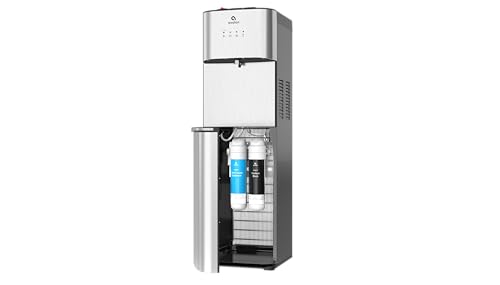
Avalon Self Cleaning Bottleless Water Cooler Water Dispenser - 3 Temperature Settings - Hot, Cold & Room Water, Durable Stainless Steel Cabinet, NSF Certified Filter- UL Listed
Included for 'Best Water Cooler Dispensers for Home and Office' because the listing specifies 3 Temperature Settings and Hot, details this guide uses to compare options.
View on AmazonThe drawback is handling. A full 5-gallon bottle can weigh roughly 40 pounds, and a top-loading design requires lifting that weight above the dispenser. A bottom-loading model solves most of the lifting problem with a small pump, although the pump adds noise and another component that can eventually wear out. Bottom loaders are also typically deeper and cost more; a reasonable market range is about $250–$600, compared with roughly $150–$350 for basic top-loading units.
Bottleless: better for high-volume use
A bottleless, or point-of-use, dispenser connects to a cold-water supply and commonly includes sediment, carbon, or more advanced filtration. It is well suited to a kitchen, workshop, or office where people refill bottles throughout the day. There are no delivery bottles to store, and the machine does not run out of water in the same way a bottle-fed unit does.
Installation is the trade-off. You need a nearby cold-water connection, accessible shutoff valve, and enough room for the tubing and filter housing. Some units can connect beneath a sink; others are designed for a dedicated line. Professional installation may add to the cost, and replacement filters are an ongoing expense. A typical bottleless purchase falls around $300–$1,000 before installation, depending on filtration, cooling capacity, and whether it produces sparkling water or ice.
Do not assume “bottleless” means maintenance-free. The inlet filter, internal reservoir, drip tray, and dispensing nozzles still need attention. If the machine will sit unused for weeks, follow the manufacturer’s procedure for shutting down and sanitizing it.
Hot and cold settings: useful feature or unnecessary cost?
Cold-only dispensers use less energy and have a simpler design. They are enough if the main goal is chilled drinking water. Cold-and-room-temperature models are a good middle ground for families that fill cooking pots or children’s bottles without wanting heated water.
Hot-and-cold models are convenient for tea, instant oatmeal, and coffee. Look for a hot-water safety lock, especially in a home with children. The heating tank also adds standby energy use and may require descaling if your water is hard. Hot output is usually warm enough for drinks rather than a replacement for boiling water, so check the stated temperature and recovery time instead of judging by the presence of a “hot” button.
For an office, pay attention to recovery rate: a small reservoir may dispense only a few cups of hot or cold water before it needs time to recover. A larger compressor-cooled unit costs more space and energy but handles repeated use better.
Measure the footprint before buying
Dispenser dimensions often look manageable until the door, bottle, and ventilation space are included. Before ordering, measure the complete installation area rather than only the empty patch of floor.
| Planning measurement | Useful target | Why it matters |
|---|---|---|
| Width of the machine | Usually 10–13 inches for a slim unit; 12–16 inches for many full-size units | Determines whether it fits beside a cabinet or refrigerator |
| Depth including door movement | Allow about 24–30 inches total | Bottom-loading doors and drip trays need usable space in front |
| Side and rear ventilation | Keep at least 2–4 inches where the manual permits | Helps the compressor release heat and avoids overheating against a wall |
| Top-loader clearance | Leave roughly 12 inches above the bottle neck or loading area | Allows a bottle to be tilted into position without striking a shelf |
| Room-size example | In a 10-by-12-foot office, reserve a 2-by-3-foot operating zone | Leaves room to stand, fill a bottle, open the cabinet, and clean the tray |
| Outlet and water line | Use a grounded outlet; keep tubing runs short and protected | Reduces cord hazards, leaks, and awkward installation |
Do not place a dispenser where a swinging door blocks a walkway or where a leak would reach electrical equipment. On uneven flooring, a stable, level base matters more than a decorative cabinet finish.
Construction details that affect durability
- Compressor cooling: Usually provides colder water and recovers more effectively than thermoelectric cooling, but it is heavier and can make a low hum.
- Stainless-steel water paths: Often resist odors and staining better than inexpensive plastic components, although the external cabinet may still be plastic.
- Removable drip tray: A tray that lifts out easily is more important than a large-looking tray that cannot be washed properly.
- Mechanical or electronic controls: Simple push paddles are easy to operate and repair; touch panels look cleaner but add electronic complexity.
- Child lock: Essential on hot-water models. Check that it requires a deliberate two-step action rather than a light accidental touch.
- Filter access: A front or side-access filter is easier to replace than one hidden behind a permanently fixed panel.
Maintenance and ownership costs
Wipe the dispensing area and drip tray weekly in a busy home or office. Clean the bottle seat whenever a bottle is changed, and sanitize the reservoirs at the interval specified by the manufacturer—commonly every few months or whenever the water develops an odor or unusual taste. Never mix cleaning chemicals, and unplug the unit before removing panels or working around water.
Bottleless owners should replace filters on schedule rather than waiting for poor taste. A filter that is overdue can restrict flow and allow trapped sediment to affect performance. Bottle-fed owners should inspect the pump tubing and bottle cap area for leaks. If a unit has a hot tank, periodic descaling may be necessary in hard-water regions.
Budget for more than the purchase price. Bottle-fed use includes bottles, deposits or delivery fees, and storage space. Bottleless use includes filters, possible plumbing work, and electricity. For a household using only a few glasses per day, the cheaper upfront bottle-fed option may remain the better value. For an office or family consuming several gallons daily, avoiding bottle handling can justify the higher initial cost.
What to choose
Choose a top-loading bottle-fed dispenser when price, portability, and simple setup matter most and someone can safely lift the bottle. Choose a bottom-loading bottle-fed dispenser for a rental or family home where you want bottle convenience without overhead lifting. Choose a bottleless dispenser when the unit will serve many people every day and a water connection is available.
For most homes, a bottom-loading hot-and-cold unit with a child lock is the balanced choice. For a small apartment, a compact cold-only or countertop model may be more sensible than paying for capacity you will not use. For a busy office, prioritize compressor cooling, recovery speed, accessible filters, and a serviceable water path over the smallest possible footprint.
Frequently asked questions
How much clearance does a water cooler need?
Follow the manual first, but plan for 2–4 inches around ventilation areas and enough front clearance to open the cabinet or remove the drip tray. Top-loading units also need roughly 12 inches above the bottle-loading area.
Is a bottom-loading cooler worth the extra cost?
It is worth considering if lifting a 40-pound bottle is difficult, unsafe, or inconvenient. It is less compelling if the cooler is used rarely and the lowest purchase price is the priority.
Can a water cooler sit beside a refrigerator?
Usually, provided both appliances have the required ventilation and the dispenser is protected from condensation, door collisions, and pooled water. Keep the power cord and any water tubing clear of walkways.