Key takeaways
- Drain port described only as “continuous drain” with no thread size. It may be a proprietary barb.
- Listing photos show a hose but no visible threaded fitting on the unit.
- Pump models that do not state lift height in feet.
- No auto-restart. One brief outage and the unit sits off until you notice.
- Capacity quoted in old-standard pints without the DOE number, which inflates the figure by roughly 40 percent.
- Filter accessible only by removing screws or the back panel.
What's inside
The drain hose connection is the feature most dehumidifier buyers skip over in the listing and regret within a month. A 50 pint unit in a damp basement fills its bucket in 8 to 12 hours, which means emptying it twice a day or accepting that the machine sits idle half the time. People buy on pint capacity, get it home, then discover the drain port is a 5/8 inch nub that no standard hose fits, or that it sits two inches off the floor and cannot gravity drain to anything but a floor drain right beside it.
The other common error is assuming any dehumidifier with a drain port can push water uphill. Most cannot; gravity drain only. If your only drain is a utility sink or a window, you need a model with a built-in pump or an external condensate pump, and those are different purchases. This guide sorts out the connection, the capacity, and the plumbing so the unit you buy runs unattended.
As an Amazon Associate we earn from qualifying purchases at no extra cost to you. Product prices and availability are accurate as of the date shown and are subject to change.



Decide These 3 Things First
1. Where the water will go. Walk the room and find the nearest floor drain, sump pit, utility sink, or exterior wall. Measure the distance and note whether the destination is below the dehumidifier’s drain port (gravity works) or above it (you need a pump). A drain port typically sits 3 to 8 inches above the floor.
2. How much moisture you are fighting. Use the room size in square feet and a damp rating. A basement that smells musty and shows condensation on pipes is “wet”; one that just feels clammy is “damp.” Capacity in pints per day scales with both.
3. Continuous or bucket-plus-drain. Nearly all mid-size units offer both, but the drain fitting type varies. The industry standard is a 3/4 inch male garden hose thread (MHT) on the unit, which takes a 3/4 inch female hose thread (FHT) hose. Confirm that thread size in the listing before you buy anything else.
Drain Fitting Type and Thread Size
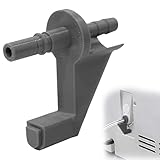
The 3/4 inch garden hose thread is the standard, and it matters because it opens up the entire world of $10 accessories. A purpose-made dehumidifier drain hose such as the 5 foot no-kink hoses at about $9.99, or the multi-length option with brass fittings at about $9.58, screws straight on. If a unit instead uses a smooth barb fitting, you are dependent on the included hose or a proprietary adapter. Some brands (AeonAir, Whirlpool, Idylis among others) use a gray push-fit connector that cracks with age; a replacement adapter runs about $14, but that is a part you should not have to hunt for. Prefer a metal or reinforced threaded port over molded plastic, and check whether the port is on the back, side, or under a panel, since a rear port against a wall needs a 90 degree elbow.
Capacity in Pints per Day
Capacity ratings under the current DOE test standard are lower than the old numbers, so a modern 35 pint unit removes roughly what a former 50 pint unit did. For a damp space of 500 to 1,000 square feet, 20 to 30 pints per day is adequate. For 1,000 to 1,500 square feet or a wet basement, choose 35 to 50 pints. Spaces over 1,500 square feet, or any space with standing water history, want 50 pints or a commercial unit. Oversizing by one class is cheaper in electricity than undersizing, because a unit that runs 24 hours to keep up never lets the compressor rest. The drain connection makes oversizing painless: with a hose, a 50 pint unit’s larger output is a non-issue.
Gravity Drain versus Built-In Pump
A gravity-drain unit needs a continuous downhill path with no rise. Keep the hose under 10 to 15 feet, avoid loops, and never let the hose end sit in standing water, which creates back-pressure and causes the unit to shut off on overflow. A built-in pump adds $50 to $100 to the price and typically lifts water 10 to 16 feet vertically, enough to reach a utility sink or a basement window. Pump models ship with a narrower, smaller-diameter hose (often 1/4 to 3/8 inch) that is separate from the gravity port. An external condensate pump, $40 to $80, does the same job for any gravity unit and is easier to replace when it fails, which pumps eventually do.
Hose Material and Kink Resistance
A drain hose is the weak link in a continuous-drain setup. Thin vinyl kinks where it bends off the port and slowly restricts flow until the bucket starts filling again. Look for hoses labeled no-kink or reinforced, 5/8 inch inside diameter, with brass or rust-resistant fittings rather than plastic. Five feet is the most common length and covers a unit sitting near a floor drain; 10 to 25 foot versions exist for longer runs, but every extra foot on a gravity system needs consistent slope. Replace a hose that has gone stiff or shows mineral crust at the fitting; at $10, it is not worth cleaning.
Noise, Power Draw, and Placement
A 30 to 50 pint dehumidifier draws 300 to 700 watts while the compressor runs, roughly the same as a window air conditioner. Running 12 hours a day, that is about 5 to 8 kWh, or $20 to $35 a month at typical rates. An ENERGY STAR model cuts that by 10 to 15 percent. Noise ranges from 45 dB on low fan to 55 dB on high, which is fine for a basement and intrusive in a bedroom. Because a drain-connected unit sits in one spot permanently, choose the location once: within hose reach of the drain, 6 to 12 inches from walls for airflow, and on a level surface so the internal float and drain pan work correctly.
Price Tiers
Budget dehumidifiers from $150 to $220 give you 20 to 30 pints, a 3/4 inch gravity drain port, and basic humidity control. Mid-range units from $220 to $320 offer 35 to 50 pints, a digital humidistat, auto-restart after a power outage (essential for unattended basement duty), and often a washable filter. Premium models from $320 to $500 add a built-in pump, Wi-Fi monitoring, and quieter compressors. Accessories are inexpensive across the board: drain hoses at $9 to $14, adapters at $10 to $15, external pumps at $40 to $80.
Warranty and Serviceability
Standard warranty is one year on the whole unit, with some brands extending the sealed refrigerant system to two to five years. Pumps are the most common failure point on pump-equipped models and are often covered only under the one-year term. Auto-restart after power loss is a must for a basement unit you check weekly. Also confirm the filter is washable and accessible without tools; a clogged filter is the leading cause of a dehumidifier icing up and quietly stopping while you assume it is working.
Spec Checklist
| Spec | Budget | Mid | Premium |
|---|---|---|---|
| Price | $150 to $220 | $220 to $320 | $320 to $500 |
| Capacity | 20 to 30 pints/day | 35 to 50 pints/day | 50 pints/day with pump |
| Coverage | Up to 1,000 sq ft | 1,000 to 2,000 sq ft | 2,000 to 4,500 sq ft |
| Drain port | 3/4 in. plastic thread | 3/4 in. thread, reinforced | 3/4 in. gravity plus pump outlet |
| Pump lift | None | None or external pump | 10 to 16 ft built in |
| Power draw | 300 to 450 W | 450 to 600 W | 500 to 700 W |
| Noise | 48 to 55 dB | 45 to 52 dB | 42 to 50 dB |
| Auto-restart | Sometimes | Yes | Yes, with Wi-Fi alerts |
| Warranty | 1 year | 1 year, 2 on sealed system | 1 to 2 years, up to 5 on sealed system |
Red Flags
- Drain port described only as “continuous drain” with no thread size. It may be a proprietary barb.
- Listing photos show a hose but no visible threaded fitting on the unit.
- Pump models that do not state lift height in feet.
- No auto-restart. One brief outage and the unit sits off until you notice.
- Capacity quoted in old-standard pints without the DOE number, which inflates the figure by roughly 40 percent.
- Filter accessible only by removing screws or the back panel.
FAQ
Will a regular garden hose work as a dehumidifier drain hose?
Mechanically yes, if the unit has a 3/4 inch garden hose thread. In practice a garden hose is heavy, stiff, and too long, which makes it hard to keep a consistent downhill slope. A dedicated 5 foot no-kink hose at about $10 is a better fit.
Can I run the drain hose to a sump pit or floor drain?
Yes, and that is the ideal setup. Keep the hose end above the water line in the pit and secure it so it cannot flip out. For a floor drain, position the hose end in the drain opening without submerging it.
Why does my dehumidifier still fill the bucket with the hose connected?
Almost always a slope or kink problem. Water backs up, the internal pan overflows into the bucket, and the float shuts the unit down. Check that every inch of hose runs downhill and that the hose is not pinched behind the unit. Some models also require removing the bucket or flipping a valve to activate the drain port.
Is a built-in pump worth the extra cost?
Only if you cannot gravity drain. If a floor drain or sump is within 10 feet and below the port, save the money. If your only option is a sink or window above the unit, a built-in pump or a $40 to $80 external pump is the difference between a dehumidifier that runs itself in 2026 and one you babysit.