Evaporative coolers are the most misunderstood cooling appliance sold. In Phoenix, Albuquerque, or Boise in June, with relative humidity at 10 to 20 percent, a swamp cooler drops air temperature 20 to 30 degrees Fahrenheit for a tenth of the electricity an air conditioner uses. In Houston it does nothing but make the room feel like a greenhouse. The first mistake buyers make is skipping that humidity check. The second is buying a tiny “4-in-1 mini air conditioner” for a bedroom and expecting room cooling; a unit with a 1 to 2 liter tank and a 3 inch fan is a personal desk cooler, not a room cooler. The third is running the unit in a closed room, which traps the moisture it releases and kills the effect within an hour.
In a genuinely dry climate, the right portable evaporative cooler is a bargain. Getting it right comes down to CFM, tank size, pad quality, and understanding that it needs a cracked window to work.
Our top picks

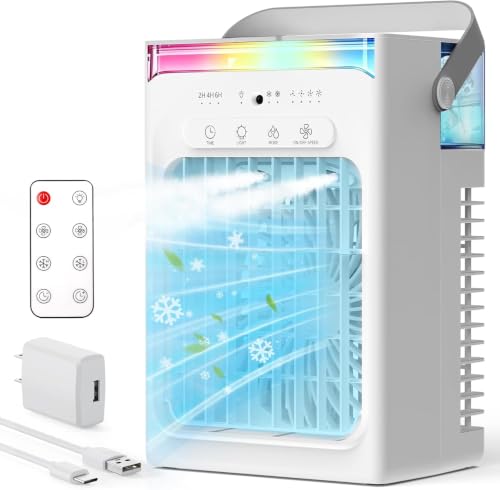
 Hessaire MC37M 3100CFM Evaporative Cooler
- Experience Superior Cooling: Embrace the evaporative air cooler…
- Transform Your Living Space: Adapt to any environment…
- Simplify Your Cooling Routine: Say goodbye to complex…

As an Amazon Associate we earn from qualifying purchases at no extra cost to you.
Decide These 3 Things First
1. Confirm your humidity. Evaporative cooling works when relative humidity is below about 50 percent and works well below 30 percent. Check the typical afternoon humidity for your area in the hottest months. At 20 percent humidity and 100 degrees Fahrenheit, the outlet air can reach about 72 degrees. At 50 percent humidity, the same 100 degree air only drops to about 86.
2. Measure the space. Evaporative coolers are sized by CFM, and the rule is roughly 2 to 3 CFM per square foot for a room with 8 foot ceilings and a cracked window. A 12 by 15 foot bedroom (180 square feet) needs 400 to 600 CFM. A 500 square foot garage or workshop needs 1,200 to 1,800 CFM. A 1,000 square foot open floor or patio needs 3,000 CFM.
3. Decide how often you will refill. A cooler consumes roughly 1 to 4 gallons of water per hour depending on size and humidity. A 10 gallon tank on a mid-size unit runs 4 to 8 hours; an 18 gallon tank runs 8 to 12. A hose connection for continuous fill removes the chore entirely for units that stay in one spot.
Airflow in CFM
CFM is the spec that matters most and the one small units hide. Personal coolers move 100 to 300 CFM and cool the area within 3 to 5 feet of the outlet; the $50 mini 4-in-1 units belong here and should be judged as desk fans with a mist function. Room coolers move 500 to 1,500 CFM and handle 150 to 500 square feet. Large portable units like the Hessaire MC37M at about $389 move 3,100 CFM, which covers 750 to 950 square feet of garage, shop, or open living space. Do not buy on tank size and assume airflow follows; the 18 gallon unit at about $340 and the 10 gallon unit at about $160 must each be checked for a CFM figure, because the tank tells you runtime, not cooling reach.
Water Tank and Fill Options
Tank size sets how long the unit runs between refills. Small room coolers carry 3 to 6 gallons and last 3 to 6 hours. Mid-size units carry 8 to 12 gallons for 6 to 10 hours. Large units carry 15 to 20 gallons and can run through a workday. Look for a top-fill door wide enough for a bucket or pitcher, a clear water level window, and a bottom drain plug for emptying and cleaning. A garden hose connection with a float valve is the single most useful feature on a unit for a garage, patio, or workshop; it turns a cooler you tend twice a day into one you switch on and forget. Weigh the trade: an 18 gallon tank full of water adds about 150 pounds, so casters and a solid frame matter.
Cooling Pad Material
The pad is where the cooling happens. Aspen wood fiber pads are cheap ($10 to $20), cool well, and need replacement every season because they sag and grow mildew. Rigid cellulose media, sometimes sold as honeycomb or high-density pads, lasts 3 to 5 seasons, resists mildew, and provides more surface area for the same size, which improves temperature drop by several degrees. Pad thickness of 2 to 4 inches on a mid-size unit, and 4 to 8 inches on a large one, indicates a serious cooler. Check that replacement pads are sold separately and note the price; a $40 pad every three years is fine, a proprietary $90 pad every year is not.
Power Draw, Noise, and Controls
This is where evaporative coolers shine. A 500 CFM room unit draws 60 to 100 watts; a 1,500 CFM unit draws 120 to 200 watts; even the 3,100 CFM Hessaire class runs on about 250 watts. A window air conditioner for the same space draws 800 to 1,500 watts. Running a mid-size cooler 10 hours a day costs $3 to $6 a month at typical rates. Noise ranges from 45 dB on low for small units to 65 dB on high for large ones, roughly the sound of a box fan. Look for at least three fan speeds, a pump switch you can turn off to run fan-only, oscillating louvers, and a remote if the unit will sit across the room.
Size, Weight, and Mobility
Room coolers stand 30 to 36 inches tall on a 12 by 14 inch footprint and weigh 15 to 25 pounds empty. Mid-size units are 36 to 42 inches tall, roughly 18 by 20 inches, and weigh 30 to 45 pounds empty. Large units like the 3,100 CFM class are about 40 by 25 by 20 inches and 40 to 60 pounds empty, closer to 200 pounds with a full 10 gallon tank. All should ride on four casters, ideally with at least two that lock. If you plan to move the cooler between a garage and a patio, confirm the doorway width against the unit’s depth and that the power cord is at least 6 to 8 feet.
Price Tiers
Personal and mini coolers run $30 to $70; the $49.99 4-in-1 mini is typical and cools one person at a desk. Room coolers from $120 to $220, such as the 10 gallon unit at $159.90, move 500 to 1,200 CFM for bedrooms and small living rooms. Large portable coolers from $300 to $450, including the 18 gallon unit at $339.99 and the Hessaire MC37M at $389, cover 700 to 1,000 square feet and are the right choice for garages, shops, and open plans. Above $500 you are into commercial units with 5,000 CFM and up, meant for warehouses and event spaces.
Warranty and Maintenance
Expect one year on most units and two years on established brands. Pumps are the usual failure point; a replacement pump costs $15 to $30 and takes ten minutes to swap on a well-designed unit, so check that the pump is accessible without tools. Maintenance is the hidden cost: drain and wipe the tank weekly to prevent mineral buildup and algae, rinse the pads every two weeks in hard-water areas, and replace pads per the material schedule. A unit with a bottom drain plug and a removable pad frame cuts weekly upkeep from 30 minutes to 10.
Spec Checklist
| Spec | Budget | Mid | Premium |
|---|---|---|---|
| Price | $30 to $120 | $120 to $250 | $300 to $450 |
| Airflow | 100 to 400 CFM | 500 to 1,500 CFM | 2,000 to 3,500 CFM |
| Coverage | Personal, up to 100 sq ft | 150 to 500 sq ft | 700 to 1,000 sq ft |
| Tank | 1 to 4 gal | 5 to 12 gal | 10 to 20 gal, hose fill |
| Runtime per fill | 2 to 5 hr | 5 to 10 hr | 8 to 12 hr or continuous |
| Pad type | Thin foam or aspen | Aspen or 2 to 4 in. cellulose | 4 to 8 in. rigid cellulose |
| Power draw | 30 to 80 W | 80 to 200 W | 200 to 300 W |
| Noise | 40 to 55 dB | 45 to 60 dB | 50 to 65 dB |
| Warranty | 1 year | 1 to 2 years | 1 to 2 years |
Red Flags
- “Air conditioner” in the name of a unit with no compressor and no exhaust hose. It is an evaporative cooler and will not cool a humid room.
- No CFM figure anywhere in the listing.
- Tank capacity in liters on a unit sold as a room cooler; 2 to 3 liters is a personal fan.
- Coverage claims over 300 square feet on a unit under 500 CFM.
- No pad replacement part number or price.
- Pump inaccessible without disassembling the housing.
- No drain plug, which means tipping a 40 pound unit to empty it.
FAQ
How much cooler will the air actually get?
It depends almost entirely on humidity. At 100 degrees Fahrenheit and 15 percent humidity, expect outlet air around 70 degrees. At 30 percent humidity, around 78. At 50 percent, around 86, which is barely useful. Dry-climate buyers should see 20 to 30 degrees of drop on a hot afternoon.
Do I really need to leave a window open?
Yes. The cooler adds moisture to the air, and in a sealed room humidity climbs until evaporation stops. Crack a window or door on the opposite side of the room a few inches so humid air exits and the cooler keeps drawing dry air. This is also why evaporative coolers work so well on patios and in garages.
Can I add ice to the tank for extra cooling?
Adding ice lowers the outlet temperature by a few degrees for the first 20 to 30 minutes, then the effect fades as the ice melts. It is a marginal gain. Filling with cool tap water and running the pump a few minutes before the fan, so the pads are saturated, does more for less effort.
How does running cost compare with a portable air conditioner?
A mid-size evaporative cooler draws 100 to 200 watts; a portable air conditioner for the same room draws 900 to 1,400 watts. Over a 2026 summer of 8 hours a day, that is a difference of roughly $30 to $60 a month at typical rates, plus the cooler’s water use of 20 to 40 gallons a day.