Key takeaways
- A non-retracting brush roll as the only floor tool. It will scratch a hardwood finish over time.
- Cord shorter than 25 feet on anything labeled commercial.
- Hard plastic wheels on the canister or the floor tool.
- No listed bag or filter part numbers, or bags sold only as a bundle with the machine.
- Amps advertised with no CFM or water lift figures.
- Warranty language that excludes commercial use.
- Hose under 5 feet, which forces you to drag the body every few steps.
What's inside
The classic hardwood floor mistake is buying a vacuum built for carpet. A spinning brush roll on a hard floor flings grit sideways instead of pulling it in, scatters debris under baseboards, and over a few years leaves a haze of micro-scratches in the finish. The second mistake is judging a commercial canister by motor amps; a 12 amp motor with a leaky hose and a bad floor tool cleans worse than a 9 amp machine with a sealed path and the right nozzle. The third is ignoring the cord. A commercial canister lives on a 30 to 50 foot cord because the person using it cannot stop every 15 feet to find an outlet, and a residential machine with an 18 foot cord doubles the cleaning time on a 2,000 square foot floor.
Commercial canisters are lighter than uprights, follow you around furniture, and put the motor on the floor instead of in your hand. For hardwood, that combination is hard to beat. Here is how to sort the field.
As an Amazon Associate we earn from qualifying purchases at no extra cost to you. Product prices and availability are accurate as of the date shown and are subject to change.


Decide These 3 Things First
1. Floor area and layout. A 1,200 square foot home with open rooms needs a different machine than a 6,000 square foot office with cubicles and cords. Count the rooms, estimate total hardwood square footage, and note stairs. Anything over 3,000 square feet of daily cleaning justifies a true commercial motor rated for 1,000 to 2,000 hours of use.
2. Bagged or bagless. Commercial units are almost always bagged for a reason: a bag is the primary filter, holds 2 to 6 quarts of fine dust without losing suction, and gets swapped in ten seconds without a cloud of debris. Bagless saves $30 to $60 a year in bags but costs filter washing time and airflow. For hardwood, where fine dust dominates, bagged wins.
3. Who is pushing it. A 9 pound canister that a cleaner can carry up stairs in one hand is a different product from a 20 pound unit meant to roll behind a floor crew. Machine weight, hose length, and wand type all trade against each other.
Floor Tool Design
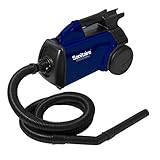
The nozzle does the actual work on hardwood. Look for a hard-floor tool 12 to 14 inches wide with a felt or horsehair strip on the leading edge and no rotating brush, or a combination tool with a brush that retracts fully. The strip protects the finish and helps create a seal so airflow lifts debris. Wheels should be soft rubber, not bare plastic, and the neck should swivel at least 180 degrees to get under furniture. Tools with a wide, low profile under 3 inches tall slide beneath sofas and credenzas. The Sanitaire SL3681A at around $140 and the Eureka 3670M at about $83 both ship with bare-floor tools and rely on straight suction, which is the correct approach for wood.
Suction, Airflow, and Sealed Path
Marketing loves amps; what matters is airflow (CFM) and water lift (inches of sealed suction). A good commercial canister moves 90 to 120 CFM at the hose end with 80 to 100 inches of water lift. On hardwood, airflow matters more than raw lift because you are moving loose debris across a smooth surface, not pulling it out of carpet pile. Just as important is a sealed system: gaskets at the bag door, hose connections, and filter housing. A machine that leaks around the bag door blows fine dust back into the room, which on a dark wood floor shows up as a fresh film within a day. Motors run 900 to 1,400 watts; a 1,000 watt sealed unit outperforms a 1,400 watt leaky one.
Weight, Hose, and Cord
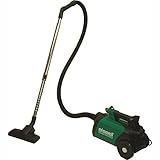
Canister body weight runs from about 8 pounds on compact commercial models to 20 pounds on heavy-duty units. For a cleaner covering multiple floors, 8 to 12 pounds is the sweet spot. Hose length of 6 to 8 feet plus a telescoping steel wand gives a reach of roughly 10 to 12 feet from the body, which means fewer stops to drag the canister forward. Cord length is where commercial units separate from residential: 30 feet is the minimum, 40 to 50 feet is standard, and the cord should be a heavy 18 or 16 gauge with a grounded plug. The Bissell BigGreen Commercial BGC3000 at about $190 is built around this portability idea, with a body you can carry or shoulder across a large floor.
Filtration and Dust Control
Bagged canisters use a two or three stage system: the bag, a motor pre-filter, and an exhaust filter. For hardwood floors, where sanding dust and fine grit dominate, specify a HEPA-rated exhaust filter or at least a microfilter bag rated to capture particles down to 1 micron. Bag capacity of 2.5 to 3.5 quarts is typical on compact units and 4 to 6 quarts on larger ones; larger bags mean fewer changes but a heavier body. Budget $2 to $4 per bag and expect to change one every 2 to 4 weeks in a busy commercial space, or every 2 to 3 months in a home.
Build Quality and Noise
Commercial housings are ABS or polycarbonate with steel wands and metal hose cuffs, versus thin plastic on consumer machines. Check that the wheels are large (2.5 inches or more) and rubberized so the canister does not mark the floor as it trails behind you. Noise runs 65 to 75 dB on most commercial canisters; anything under 68 dB is quiet enough for daytime use in an occupied office. Motor life is the real durability spec: commercial motors are rated for 1,000 to 2,000 hours, roughly five to ten years of daily use, and replacement motors and brushes are sold as parts. If you cannot find a parts diagram for a machine, it is not truly commercial.
Price Tiers and What You Get
Budget commercial canisters run $80 to $130 and give you a bagged body, a bare-floor tool, a 20 to 25 foot cord, and a one-year warranty; the Eureka 3670M at $82.99 sits at this level. Mid-range machines from $130 to $220, including the Sanitaire SL3681A at $139.99 and the Bissell BGC3000 at $189.95, add longer cords, sealed filtration, steel wands, and two to three year commercial warranties. Premium canisters from $250 to $600 bring HEPA sealing, quieter motors under 65 dB, and 50 foot cords with electrified hoses for power nozzles. For comparison, a commercial bagged upright like the Oreck Commercial XL at about $189 covers open floors fast but lacks the canister’s reach under furniture, so it suits hallways and lobbies more than furnished rooms.
Warranty and Parts
Consumer vacuums carry one year of coverage; commercial units typically carry one to three years on the whole machine and sometimes longer on the motor, with warranties that stay valid under commercial use (many residential warranties void the moment a cleaning business uses the machine). Check that bags, filters, hoses, and floor tools are stocked individually. A machine with a $6 replacement hose cuff and a $25 floor tool will still be running in eight years; one with no parts channel becomes landfill when a $4 part cracks.
Spec Checklist
| Spec | Budget | Mid | Premium |
|---|---|---|---|
| Price | $80 to $130 | $130 to $220 | $250 to $600 |
| Body weight | 8 to 10 lb | 9 to 14 lb | 12 to 20 lb |
| Motor | 900 to 1,100 W | 1,000 to 1,300 W | 1,200 to 1,400 W |
| Cord length | 20 to 25 ft | 30 to 40 ft | 40 to 50 ft |
| Hose and wand reach | 8 to 10 ft | 10 to 12 ft | 12 to 14 ft |
| Bag capacity | 2 to 3 qt | 2.5 to 4 qt | 4 to 6 qt |
| Filtration | Standard bag plus foam | Microfilter bag, sealed door | HEPA exhaust, fully sealed |
| Noise | 72 to 78 dB | 68 to 74 dB | 60 to 68 dB |
| Warranty | 1 year | 1 to 3 years | 3 to 5 years |
Red Flags
- A non-retracting brush roll as the only floor tool. It will scratch a hardwood finish over time.
- Cord shorter than 25 feet on anything labeled commercial.
- Hard plastic wheels on the canister or the floor tool.
- No listed bag or filter part numbers, or bags sold only as a bundle with the machine.
- Amps advertised with no CFM or water lift figures.
- Warranty language that excludes commercial use.
- Hose under 5 feet, which forces you to drag the body every few steps.
FAQ
Is a canister really better than an upright for hardwood floors?
For furnished rooms, yes. A canister’s low floor tool slides under beds and sofas, the body is lighter to carry between rooms, and straight suction with a felt strip is gentler on finishes than an upright’s brush roll. Uprights like the Oreck Commercial XL win on wide-open floors where speed matters more than reach.
How many amps or watts do I need?
For hardwood, 900 to 1,200 watts (roughly 8 to 10 amps) is plenty if the system is sealed and the floor tool fits the surface. Extra power mostly adds noise and heat; it does not lift more debris off a smooth floor.
Will a commercial canister damage my finish?
Not if you use a bare-floor tool with a felt or bristle strip and soft wheels. Damage comes from grit trapped under a hard plastic tool or a spinning brush. Check the underside of the nozzle for embedded debris every few sessions.
How often should bags and filters be changed?
Change the bag when it is two-thirds full or when suction noticeably drops, typically every 2 to 4 weeks in commercial use. Rinse or replace the motor pre-filter every 3 to 6 months and the exhaust filter annually. Doing this in 2026 costs $40 to $80 a year, far less than the motor you save.