
Key takeaways
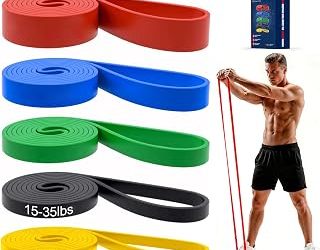
- Match the band shape to the movement. Tubes with handles win for pressing, curling, and cable-style rows. Continuous loops win for squats, deadlifts, pull-up assistance, and anything you want to stand on or wrap around a rack.
- Look for layered latex, not molded rubber. Quality loops are built from dozens of thin latex sheets laminated together, so a nick stays local instead of propagating into a full rupture. Tubes should have a woven safety cord threaded through the core.
- Buy overlapping resistance, not a ladder of extremes. Three bands you can combine beat five you can’t. Stackable systems let you add ten pounds at a time, which matters far more for progression than a single monstrous band.
- Inspect the hardware. Snap-hooks and carabiners fail before latex does. Metal clips with a spring gate and a rotating collar outlast plastic hooks, and a door anchor should use a thick foam-wrapped ball rather than a bare knot.
- Account for latex sensitivity and storage. If anyone in the house reacts to latex, choose a TPE or elastomer alternative. Whatever you buy, keep it out of direct sun and away from radiators — UV and heat degrade elastic far faster than reps do.
What's inside
A 41-inch loop band folded flat weighs about six ounces and fits in a coat pocket, yet stretched to its limit it can push back with more than 150 pounds of force. That ratio — negligible mass, serious tension — is the whole argument for resistance bands. I’ve run entire training blocks off a door anchor and four tubes while traveling, and the honest verdict is that bands won’t replace a heavy barbell for maximal strength, but they will absolutely cover pressing, rowing, hinging, squatting, and every rotator-cuff detail your shoulders have been begging for.
The catch is that “resistance band” describes at least four different tools. Layered continuous loops behave nothing like clip-on tubes with handles; a 0.5-inch physio band and a 2.5-inch pull-up assistance band share a category and almost nothing else. Below are the sets I keep coming back to, sorted by what they’re actually good at, plus the specification details — latex layering, carabiner quality, anchor design — that separate a set you’ll still use in three years from one that snaps mid-rep and ends up in a drawer.
As an Amazon Associate we earn from qualifying purchases at no extra cost to you. Product prices and availability are accurate as of the date shown and are subject to change.


As an Amazon Associate we earn from qualifying purchases at no extra cost to you. Product prices and availability are accurate as of the date shown and are subject to change.
Quick Comparison
| Set | Style | Resistance Range | Anchor Included | Best For |
|---|---|---|---|---|
| Bodylastics Stackable Tube Set | Clip-on tubes with handles | ~5–400 lb stacked | Door anchor + ankle straps | Full-body strength programming |
| Undersun Fitness 5-Band Set | Layered continuous loops | ~5–120 lb per band | Sold separately | Durability and heavy compounds |
| WHATAFIT 11-Piece Kit | Clip-on tubes with handles | ~10–150 lb stacked | Door anchor + ankle straps | Budget-conscious beginners |
| TheraBand CLX | Flat band, 11 built-in loops | Color-coded, light to heavy | Not required | Rehab, shoulders, mobility |
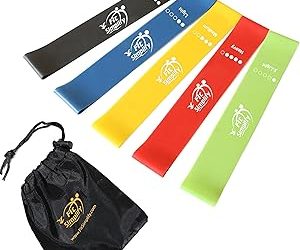
| Fit Simplify Loop Bands | Mini loops (5-pack) | ~2–30 lb | N/A | Hips, glutes, warm-ups |
How to Choose
- Match the band shape to the movement. Tubes with handles win for pressing, curling, and cable-style rows. Continuous loops win for squats, deadlifts, pull-up assistance, and anything you want to stand on or wrap around a rack.
- Look for layered latex, not molded rubber. Quality loops are built from dozens of thin latex sheets laminated together, so a nick stays local instead of propagating into a full rupture. Tubes should have a woven safety cord threaded through the core.
- Buy overlapping resistance, not a ladder of extremes. Three bands you can combine beat five you can’t. Stackable systems let you add ten pounds at a time, which matters far more for progression than a single monstrous band.
- Inspect the hardware. Snap-hooks and carabiners fail before latex does. Metal clips with a spring gate and a rotating collar outlast plastic hooks, and a door anchor should use a thick foam-wrapped ball rather than a bare knot.
- Account for latex sensitivity and storage. If anyone in the house reacts to latex, choose a TPE or elastomer alternative. Whatever you buy, keep it out of direct sun and away from radiators — UV and heat degrade elastic far faster than reps do.
Top Picks Reviewed
Bodylastics Stackable Tube Set — Best Overall
This is the system I recommend when someone wants bands to be their primary training tool. Each tube has an internal Kevlar-style cord that limits travel and prevents catastrophic snap-back, and the clip design means you can stack five tubes onto one handle for genuinely heavy pressing. The door anchor is thick and well-padded, the ankle straps are wide enough for cable-style kickbacks and hip abduction, and the whole kit collapses into a bag smaller than a shoebox. The trade-off: clipping and unclipping between exercises adds a few seconds, which is mildly annoying during circuits.
Undersun Fitness 5-Band Set — Best for Durability
These are thick, layered, continuous loops built for people who intend to abuse them. Loop the extra-heavy band under your feet for squats or over a bar for pull-up assistance and it holds tension without the thin, squeaky feel of cheaper loops. Because there are no clips or handles, everything runs through your body position — which is either elegant simplicity or a limitation, depending on how you train. Pair them with a door anchor and a pair of handles and the same five bands cover rows, presses, hinges, and carries.
WHATAFIT 11-Piece Kit — Best Value
For the price of two protein tubs, you get five stackable tubes, two handles, ankle straps, a door anchor, and a carry pouch. The latex is thinner than premium sets and the plastic-cored handles will eventually feel loose, but stacked to roughly 150 pounds it covers everything a newer lifter needs for at least a year of consistent work. I treat it as a starter kit or a travel backup rather than a lifetime purchase, and I’d inspect the clips every couple of months for wear at the crimp.
TheraBand CLX — Best for Rehab and Shoulders
The CLX is a flat band with eleven sewn-in loops running its length, which sounds gimmicky until you use it. Slip a hand or foot into whichever loop gives the right lever length and suddenly you have precise, repeatable positions for external rotation, scapular retraction, and lateral walks. Resistance follows the familiar clinical color scale, so progression is unambiguous. It’s not the tool for heavy squats, but for prehab, warm-ups, and honest shoulder maintenance nothing else is this convenient.
Fit Simplify Loop Bands — Best Mini Bands
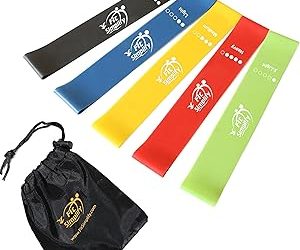
Five short fabric-free latex loops covering roughly two to thirty pounds. Their job is small and specific: firing up the glutes before a lower-body session, adding tension to hip thrusts and monster walks, and rehabbing knees through banded terminal extensions. They roll up during heavy hip work — the price of being non-fabric — but they’re cheap enough to keep a set in every gym bag, and they last far longer than their price suggests.
Frequently Asked Questions
Can resistance bands actually build muscle?
Yes. Hypertrophy responds to mechanical tension and proximity to failure, not to the specific object creating the load. Studies comparing elastic and conventional resistance training repeatedly find similar strength and size outcomes when effort is matched. Where bands lag is measurable loading — you’re estimating tension rather than counting plates — and peak force at the bottom of a movement, since bands are lightest exactly where many lifts are hardest.
Which resistance level should I start with?
Buy a set with overlap rather than guessing at one band. As a rough guide, light bands (5–20 lb) handle shoulders, arms, and rotator-cuff work; medium bands (20–50 lb) cover rows, presses, and upper-back work; heavy bands (50 lb and up) are for squats, hinges, and pull-up assistance. If you can complete twenty clean reps without any struggle, you need the next band up.
How do I stop a band from snapping?
Most failures come from abrasion, not tension. Never stretch a band over a rough edge, a bare rack upright, or a doorframe corner — use a padded anchor or a towel. Avoid standing on loops with cleated shoes, keep bands under about 250% of resting length, and store them coiled somewhere dark and cool. Inspect for surface cracks or shiny thinned spots, and retire anything showing them.
Bands or dumbbells if I can only buy one?
Bands, if your constraints are space, budget, or travel; adjustable dumbbells, if you have a corner to spare and want precise, repeatable loading. Bands are also gentler on joints through the bottom range and easier to scale mid-set. A single pair of moderate dumbbells plus a band set is, for most home setups, the highest-value combination available.
Final Thoughts
If you want one purchase that handles a genuine full-body program, get the Bodylastics stackable system and add a set of mini loops for warm-ups. If you’d rather own tools that will outlive several apartments, buy the Undersun loops and a pair of handles. Whichever direction you go, the useful move is to hang the bands where you’ll trip over them — a hook by the door, not a bin in the closet. Bands don’t fail because they’re inadequate; they fail because they’re out of sight.
FAQ
Can resistance bands actually build muscle?
Which resistance level should I start with?
How do I stop a band from snapping?
Bands or dumbbells if I can only buy one?
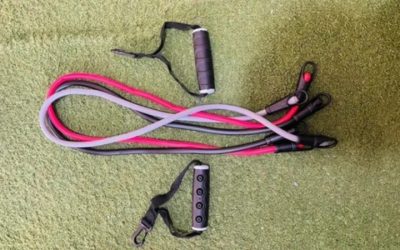
Best Pedal Resistance Bands: 6 Seated Training Picks Rated
Best pedal resistance bands shopping runs into an unusual problem: the category...
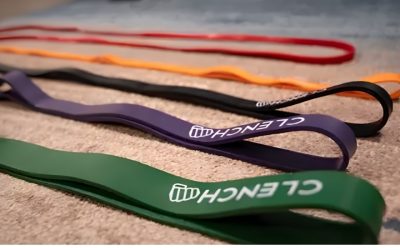
Best Resistance Bands Women Use: 6 Picks by Band Format
Best resistance bands women shop for tend to fall into three formats...
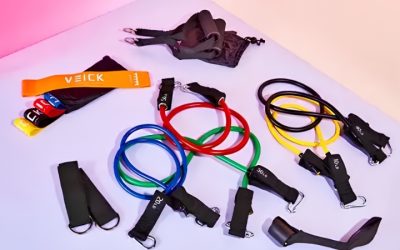
Best Resistance Bands for Men: 5 Sets by Strength Level
Open a new set of natural latex bands indoors and you will...
Best Resistance Bands Leggings: 6 Pairs for Home Training
The failure mode is always the same. You’re three reps into...
Best Resistance Bands Workout Gear for Full Body Strength
A resistance band does something a dumbbell physically cannot: it gets...
Best Resistance Training Bands: Build a Set That Progresses
A resistance band is only useful for as long as it...
Best Resistance Exercise Bands: 6 Types and When to Use Each
Best resistance exercise bands depends entirely on format, because a stackable tube...
Write Your Review
No reviews yet. Be the first to share your experience!