Key takeaways
- 3.5 cubic feet: roughly 10–14 medium meal containers plus frozen goods, depending on packaging.
- 5.0 cubic feet: better for bulk meat packs, batch-cooked meals, and several weeks of frozen staples.
- 7.0 cubic feet: more practical for a family, but usually too large for a very tight utility area.
The best small chest freezers for compact storage are usually 3.5–5.0-cubic-foot models: small enough for a utility room or apartment, but large enough for several bags of frozen food, meal-prep containers, or a modest bulk purchase. For the easiest fit, choose a freezer no wider than 34 inches, leave at least 3 inches of ventilation space on the sides and back, and reserve about 24–30 inches above the lid for opening.
Quick picks by situation
| Best for | Recommended type or example | Typical capacity | Why it fits | Main compromise |
|---|---|---|---|---|
| Small apartment or utility closet | Compact 3.5-cu.-ft. chest freezer, such as an Arctic King compact model | 3.5 cu. ft. | Usually about 33–34 inches wide and easier to place along a wall | One basket and limited room for tall packages |
| Best all-round capacity | GE FCM5SKWW or Midea 5.0-cu.-ft. chest freezer | 5.0 cu. ft. | Useful capacity without the footprint of a 7-cubic-foot freezer | Still needs roughly 20–21 inches of floor depth |
| Organized meal prep | 5.0-cu.-ft. model with a removable sliding basket | About 5 cu. ft. | Basket separates frequently used food from the lower compartment | Basket space reduces usable vertical storage |
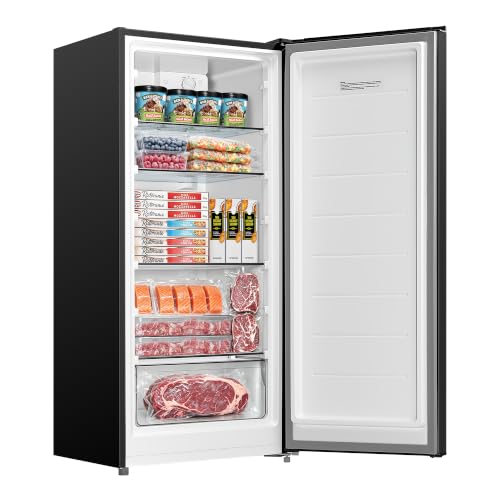
| Very tight floor area | Small upright freezer rather than a chest freezer | 3–5 cu. ft. | Uses less floor width and provides shelves | Often costs more to run and may lose cold faster during a power outage |
| Garage or unheated utility space | Chest freezer specifically rated for the intended ambient temperature | 3.5–5 cu. ft. | Chest insulation helps maintain temperature in changing conditions | Not every compact model is approved for extreme heat or cold |
Best small chest freezers compared
GE FCM5SKWW: the balanced 5-cubic-foot choice
The GE FCM5SKWW is a sensible starting point when you want more usable storage than a 3.5-cubic-foot freezer but cannot accommodate a full-size chest model. Its footprint is approximately 33.5 inches wide by 20.6 inches deep, with a cabinet height around 33.5 inches. The single sliding storage basket is useful for smaller packages and food you use often, while larger items can sit below it.

Midea 3.5 Cu.ft Chest Freezer, Fridge Freezer Convertible with LED Light
Included for 'Best Small Chest Freezers for Compact Storage' because the listing specifies Fridge Freezer Convertible with LED Light, details this guide uses to compare options.
View on Amazon
Kismile 3.2 Cubic Feet Chest Freezer, Small Deep Freezer for Home, Black
Included for 'Best Small Chest Freezers for Compact Storage' because the listing specifies Small Deep Freezer for Home and Black, details this guide uses to compare options.
View on Amazon
EUHOMY 1.8 Cu.Ft Chest Freezer, Small Deep Freezer Top Door, Black
Included for 'Best Small Chest Freezers for Compact Storage' because the listing specifies Small Deep Freezer Top Door and Black, details this guide uses to compare options.
View on Amazon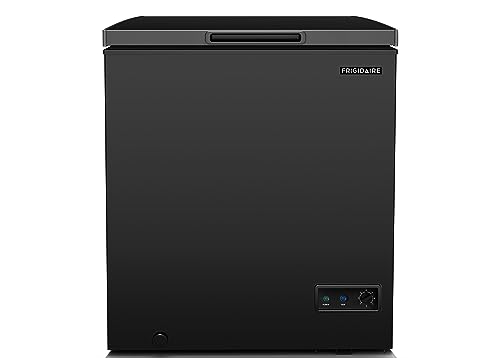
FRIGIDAIRE EFRF5003-BLACK Chest Deep Freezer-Garage-Ready, 5.0 Cu. Ft. Capacity, Black-Adjustable Thermostat-Removable Vinyl Coated Wire Basket-Easy Defrost Drain
Included for 'Best Small Chest Freezers for Compact Storage' because the listing specifies 5.0 Cu. Ft. Capacity, details this guide uses to compare options.
View on AmazonExpect a mechanical temperature control and a temperature range suitable for normal frozen-food storage, generally around 0°F when correctly adjusted. A 5-cubic-foot freezer commonly uses roughly 200–300 kilowatt-hours per year, although the exact figure depends on the production revision, room temperature, thermostat setting, and how often the lid is opened.
This is a good fit beside a workbench or under a sturdy utility-room window, but it is not genuinely “under-counter” in the kitchen sense. A counter is usually 34–36 inches high, while chest-freezer lids need clearance to swing upward. The cabinet may fit below a counter-height surface, but the lid will not open if a fixed worktop is directly above it.
Midea 5.0-cu.-ft. chest freezer: strong capacity for a narrow footprint
Midea’s 5.0-cubic-foot chest freezers are close competitors to the GE in floor dimensions and storage volume. Many versions use one removable wire basket, a front drain for manual defrosting, and an adjustable mechanical thermostat. Check the exact model label before buying because Midea sells closely related versions with different controls, handles, and energy specifications.
The advantage is efficient use of a footprint roughly 34 inches wide and 21 inches deep. That makes it practical in a 10-by-12-foot utility room, where it can sit along one wall without consuming the central walkway. Keep a 30-inch passage in front if you want to lift the lid and stand comfortably while sorting food. If the freezer faces a washer or dryer, measure the door-open position rather than only the closed cabinet.
Like most compact chest freezers, it requires manual defrosting. Plan on removing food once or twice a year, depending on humidity and frost buildup. A plastic scraper, towels, and a shallow tray make the task manageable; never chip ice with a knife or sharp metal tool.
Arctic King compact chest freezer: the space-saving budget option
An Arctic King freezer in the 3.5-cubic-foot class is better suited to a small apartment, rental laundry area, or overflow storage for one or two people. These models commonly measure about 33–34 inches wide and approximately 20–21 inches deep. That is only slightly narrower than many 5-cubic-foot freezers, so the capacity difference matters more than the floor savings.
The interior usually has one hanging basket and enough room for frozen vegetables, meat packages, ice cream, and prepared meals. A 3.5-cubic-foot capacity is not ideal for stacking large boxes or storing a quarter of a cow; food can become difficult to retrieve once it is packed below the basket.
Its lower purchase price—often within the general compact-freezer market range of about $180–$350—can make sense for renters or occasional use. Before placing it in a garage, verify the model’s permitted ambient-temperature range. A freezer designed for indoor conditions may work poorly in a very hot garage or an unheated space during winter.
Insignia 5.0-cu.-ft. chest freezer: a practical organization-focused alternative
Insignia’s 5.0-cubic-foot chest-freezer models are worth considering when the priority is a familiar compact format with a removable storage basket and simple temperature adjustment. Dimensions are typically in the same approximately 33–34-inch-wide, 20–21-inch-deep class as other 5-cubic-foot units, but confirm the specification sheet for the exact model.
The single-basket layout is easy to understand but creates a predictable trade-off: frequently used food is accessible, while items underneath require lifting the basket or unloading the top layer. To reduce wasted space, use flat, labeled containers and group food by category rather than filling the freezer with irregular bags.
What the capacity numbers mean in daily use
Chest-freezer capacity is measured as internal volume, not the number of conveniently accessible packages. A 3.5-cubic-foot model is generally suitable for one or two people who buy frozen food routinely. A 5.0-cubic-foot model gives a household of two to four people more flexibility for batch cooking, but it still cannot replace a large basement freezer.
- 3.5 cubic feet: roughly 10–14 medium meal containers plus frozen goods, depending on packaging.
- 5.0 cubic feet: better for bulk meat packs, batch-cooked meals, and several weeks of frozen staples.
- 7.0 cubic feet: more practical for a family, but usually too large for a very tight utility area.
Leave some space around packages so cold air can circulate. Overpacking also makes the bottom layer hard to reach, which can lead to freezer burn and expired food being forgotten.
Energy use, temperature, and defrosting effort
| Feature | What to look for | Why it matters in a small home |
|---|---|---|
| Temperature control | Adjustable thermostat and a target near 0°F | Allows safer storage without forcing the compressor to run unnecessarily |
| Annual energy use | Often about 200–300 kWh for compact 3.5–5-cu.-ft. models | Use the yellow EnergyGuide label to compare exact models |
| Defrosting | Manual defrost with a drain plug or drain outlet | Usually more efficient and cheaper than automatic-defrost designs, but requires periodic labor |
| Basket layout | One removable basket, or two if the cabinet is wide enough | Keeps small items accessible and reduces digging through frozen food |
Chest freezers are commonly more energy-efficient than similarly sized upright freezers because cold air does not spill out as readily when the lid opens. A manual-defrost design also tends to use less electricity than an automatic-defrost appliance. However, frost thicker than about 1/4 inch reduces usable space and makes the compressor work harder, so defrost before the ice becomes a solid shell.
Fit and moving details people often miss
Measure the doorway, stair turn, and final location before ordering. A compact freezer that is 34 inches wide may still arrive in a box several inches wider or taller. The appliance itself may weigh roughly 60–90 pounds, so two adults are usually safer for carrying it. Keep it upright during transport when possible; if it must be tilted, follow the manufacturer’s waiting period before plugging it in.
Do not place the freezer directly against drywall, a radiator, a furnace, or a washing machine that vibrates heavily. Leave at least 3 inches on the sides and rear unless the manual specifies more. The lid needs unobstructed vertical travel, and you need enough standing room to lift a basket without twisting your back. For someone with back pain, a smaller freezer that can be sorted in layers is often better than a larger, deeper model packed to the top.
Bottom line
Choose a 3.5-cubic-foot Arctic King-style compact freezer when floor space and purchase cost matter most. Choose the GE FCM5SKWW or a comparable Midea 5.0-cubic-foot model for the best balance of footprint and usable capacity. An Insignia 5.0-cubic-foot model is a reasonable alternative when its basket arrangement and published energy figures suit your layout. Whichever you select, prioritize the actual exterior dimensions, lid clearance, ambient-temperature rating, annual kWh figure, and drain design over capacity alone.