Our Top Picks
 DUMOS 31.5" Folding Computer Desk31.5"W x 15.7"D15.7 x 31.5 x 29.52 inches13.4 poundsCheck on Amazon
Choose a wall-mounted fold-down desk if you want a work surface that disappears completely in a small room, a gateleg or drop-leaf desk if you want a traditional piece that expands on demand, and a freestanding foldable table with legs that collapse flat if you need a workspace that can be stored behind a door or in a closet. The right pick comes down to how often you work at it, how much weight it must carry, and whether you can drill into a wall.
At a glance: folding desk types compared
| Type | Best for | Key traits commonly stated | Limits |
|---|---|---|---|
| Wall-mounted fold-down desk | Small apartments, entryways, shared rooms | Hinged top that lifts to a vertical position, mounting hardware included, some with shelves or storage | Needs secure wall mounting; load limit depends on the wall and hardware |
| Freestanding folding desk with flat-collapsing legs | Occasional work, renters, students | No assembly in many cases, legs fold under the top, light to carry | Less stable than fixed desks; surface can flex under heavy monitors |
| Drop-leaf or gateleg desk | Living rooms, guest rooms, home offices that double as dining space | Hinged leaves that raise on a swing-out leg, wooden construction | Heavier, takes floor space even when folded |
| Folding desk with built-in storage | Dorm rooms and bedrooms | Shelves, drawers or cubbies that fold with the desk | More parts to assemble; heavier |
| Standing and sitting convertible folding desk | People who alternate positions | Adjustable height mechanism with foldable base | Weaker stability at maximum height; limited capacity |
How to choose: space, stability and load
Before comparing models, measure the floor or wall space and the room you need around the chair. A folding desk is only convenient if you will really fold it away. If you leave it open all day, a standard compact desk may be a better value, since folding hardware adds cost and a potential weak point.

TEMI Small Computer Desk Folding Table - 35.8" Foldable Office Desk, No Assembly, Perfect for Small Spaces in Bedroom, Dorm, or Apartment, Study Table with Compact Design, Brown
Chosen because it specifies 35.8" Foldable Office Desk and No Assembly.
View on Amazon
Huuger Folding Desk for Small Spaces, 31.5 Inch Foldable Computer Table | Easy Assembly, Small Writing Work Office Computer Desk, for Home Office, Study, Bedroom, Dorm, Space Saving, Rustic Brown
Chosen because it specifies 31.5 Inch Foldable Computer Table and Easy Assembly.
View on Amazon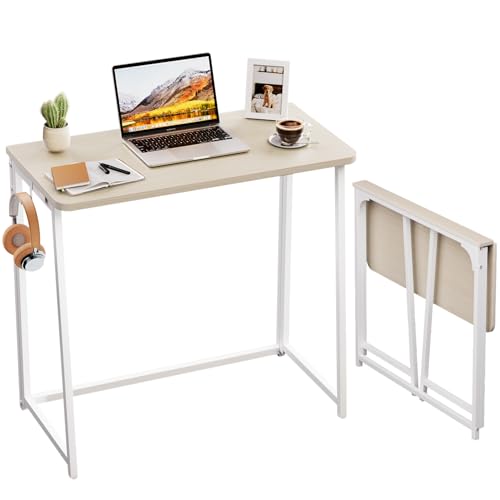
WOHOMO Folding Desk, 31.5" Foldable Computer Table for Small Spaces, Oak | Easy Assembly and Fold, Sturdy Home office desks for Study Bedroom Dorm Space Saving Writing Work Apartment
Chosen because it specifies 31.5" Foldable Computer Table for Small Spaces and Oak.
View on AmazonDUMOS 31.5" Folding Computer Desk, Foldable Table for Small Spaces, Black | Home Office Desks, Sturdy Study Work Writing Table for Bedroom Dorm Apartment Space Saving with Metal Frame Easy Assenbly
Chosen because it specifies Foldable Table for Small Spaces and Black.
View on AmazonStability
Folding mechanisms mean joints, and joints can wobble. Reviewers of foldable desks regularly report that the stiffest models use metal frames with locking braces, while the lightest ones can shake as you type. If you plan to use a laptop and a mouse, a small amount of flex is usually tolerable. If you want a monitor, keyboard and other equipment, check the maker’s stated weight capacity and choose a design with cross-bracing.
Wall-mounted safety
For wall-mounted fold-down desks, the wall and the fasteners carry the load. Use the hardware the maker supplies only if it suits your wall, and locate studs or use anchors rated for the weight. If you are unsure about the wall type, particularly plaster, masonry or thin drywall, ask a qualified installer. Do not exceed the maker’s stated load rating and avoid sitting or leaning on the open surface unless the manual says it is allowed.
Materials
- Engineered wood (MDF, particleboard): Lightweight and common at budget and mid-range levels. Surfaces are typically laminate, which wipes clean but can chip at the edges.
- Solid wood or plywood: Found on gateleg and premium wall desks, and generally more durable and repairable.
- Steel frames: Used for collapsible legs and brackets. Look for powder-coated finishes and check that rubber feet protect floors.
- Bamboo: Offered by a number of makers as a renewable alternative, with a natural appearance. Check the stated finish and weight capacity.
Notable lines to consider
The following are examples of widely sold lines in this category, described by what their makers say about them. Check each current listing for dimensions, weight limits and care instructions, because models are updated and renamed over time.
- IKEA wall-mounted fold-down tables: The maker offers drop-leaf style wall tables that fold flat against the wall, aimed at small spaces and often paired with their own mounting hardware. They suit light desk work.
- Flexispot and similar convertible desks: Flexispot is best known for height-adjustable desks, and some of its smaller lines are marketed to compact rooms. Check whether a specific model actually folds.
- Songmics, Costway and Vasagle foldable computer desks: These brands sell flat-folding desks and gateleg tables with steel frames and engineered tops, usually positioned in the budget and mid-range tiers.
- Folding wall desks from Delta Children or Prepac: Prepac, for example, lists floating or wall-mounted desks that fold up, aimed at small bedrooms and home offices.
Because specifications change often, treat these as starting points for research rather than fixed picks, and read the maker’s current dimensions and load ratings.
Fit and size notes
- Surface depth: A depth of around 20 to 24 inches is comfortable for a laptop, while 24 to 30 inches suits a monitor and keyboard.
- Width: Roughly 30 to 48 inches works for a single user. Wider surfaces allow dual monitors but require more wall or floor space.
- Height: Standard desks sit around 28 to 30 inches. Wall-mounted types let you choose the height on installation, which helps match chair and user height.
- Clearance: When folded, a freestanding desk needs a closet or gap behind a sofa. A wall desk needs open wall depth to swing the top up.
Care and safety notes
Keep fingers clear of hinges and folding joints. Check screws and braces periodically, as folding mechanisms loosen with use. Follow the maker’s weight limits and do not stack heavy items on the surface while folded. Avoid dragging a freestanding desk across floors; lift or use the rubber feet to protect surfaces. Wipe laminate and wood tops with a lightly damp cloth, and dry them promptly.
Ergonomics matter too. A folding desk can encourage you to work from a sofa or edge of the bed, which may be uncomfortable over time. If you have persistent neck, back or wrist discomfort, speak with a healthcare professional about your workspace setup.
Budget tiers and trade-offs
Budget
Budget folding desks are generally lightweight steel and MDF, often sold as ready-to-use with little assembly. They are fine for a laptop and a notebook. Expect more wobble and a lower weight limit.
Mid-range
Mid-range models typically have sturdier frames, thicker tops and more finish options, and some include storage. This is the best tier for daily use in a small apartment.
Premium
Premium folding desks use solid wood or high-grade plywood and better hardware. They can function as permanent furniture and are often easier to repair, but they cost more and are heavier to install.
Pick X if…
| Pick this | If you… |
|---|---|
| Wall-mounted fold-down desk | can drill into the wall and want the floor clear when not working |
| Freestanding flat-folding desk | rent, move often or need to store it in a closet |
| Gateleg or drop-leaf desk | want a traditional look that also works as a table |
| Desk with built-in shelving | need to keep supplies close in a dorm or bedroom |
| Convertible sit-stand desk | alternate positions through the day |
Alternatives
- Compact fixed desk: If you are always working at the same spot, a slim fixed desk can be sturdier and cheaper.
- Lap desk or laptop tray: For occasional laptop use on a sofa or bed, a tray is simpler, though it does not suit long hours.
- Secretary desk or wall cabinet: A cabinet with a drop-down writing surface hides clutter behind doors and suits living rooms.
Setting up a small workspace around a folding desk
A folding desk works best when the rest of the setup is just as easy to put away. Keep a lidded box or shallow drawer nearby for cables, notebooks and a laptop stand so you can clear the surface in a minute. A portable laptop riser and a separate keyboard improve posture compared with typing on a low, flat laptop. Choose a chair that tucks fully under or beside the desk, and consider a stackable stool or folding chair if floor space is tight. Good lighting is just as important in a corner room: a clip-on or small desk lamp avoids glare on screens. If the desk is mounted on a shared wall, remember that typing and moving objects can carry noise to neighbours or roommates, so rubber pads under items can help. Finally, test the folded position for a week before deciding where to keep the desk permanently.
Frequently Asked Questions
Are folding desks sturdy enough for daily work?
Some are, particularly wall-mounted types with proper anchoring and models with steel braces. Lightweight freestanding versions can wobble, so they suit occasional use better than full-time work. Check the weight capacity the maker states.
Can a folding desk hold a monitor?
Many can, provided the stated weight limit covers the monitor and accessories and the surface depth is enough. Place the monitor near the legs or supports rather than the centre of an unsupported span.
How do I mount a fold-down wall desk safely?
Follow the manual, locate studs where possible and use fasteners rated for the wall type and load. If you have plaster, masonry or are unsure, ask a qualified installer. Do not exceed the stated load rating.
What is the best size for a small-space folding desk?
A depth of about 20 to 24 inches and a width of 30 to 40 inches works for a laptop. If you need a monitor and keyboard, aim for more depth and check the clearance for your chair.
Do folding desks work for standing?
Only models designed for it. Most folding desks are fixed-height, so standing use depends on the height you choose for wall mounting. A true sit-stand desk uses a lifting mechanism and has its own capacity limit.
How do I keep a freestanding folding desk from wobbling?
Make sure the legs are fully locked, the floor is level and any adjustable feet are set. Tighten screws periodically and avoid heavy loads at the edge of the surface.