Key takeaways
- Identify freezer defrost type by compartment and compare the owner maintenance requirements before choosing a model.
What's inside
Before buying a freezer, identify its documented defrost system and the maintenance it leaves to the owner. For a refrigerator with a freezer compartment, check each compartment separately. “Automatic defrost” in a short listing may not describe the freezer section, and a frost-free label does not mean the entire appliance needs no care.
Read the full model specification
Save the complete model number, market and current product sheet. Look for the defrost description in the specifications and then find the corresponding section of the owner’s manual. A retailer’s category filter is a starting point, not the final maintenance instruction.
For a standalone freezer, confirm that the defrost term applies to its storage compartment. For a combination appliance, make separate rows for fresh food and frozen food. Do not infer the system from the number of doors, the shape of the cabinet or whether it is marketed for a garage.
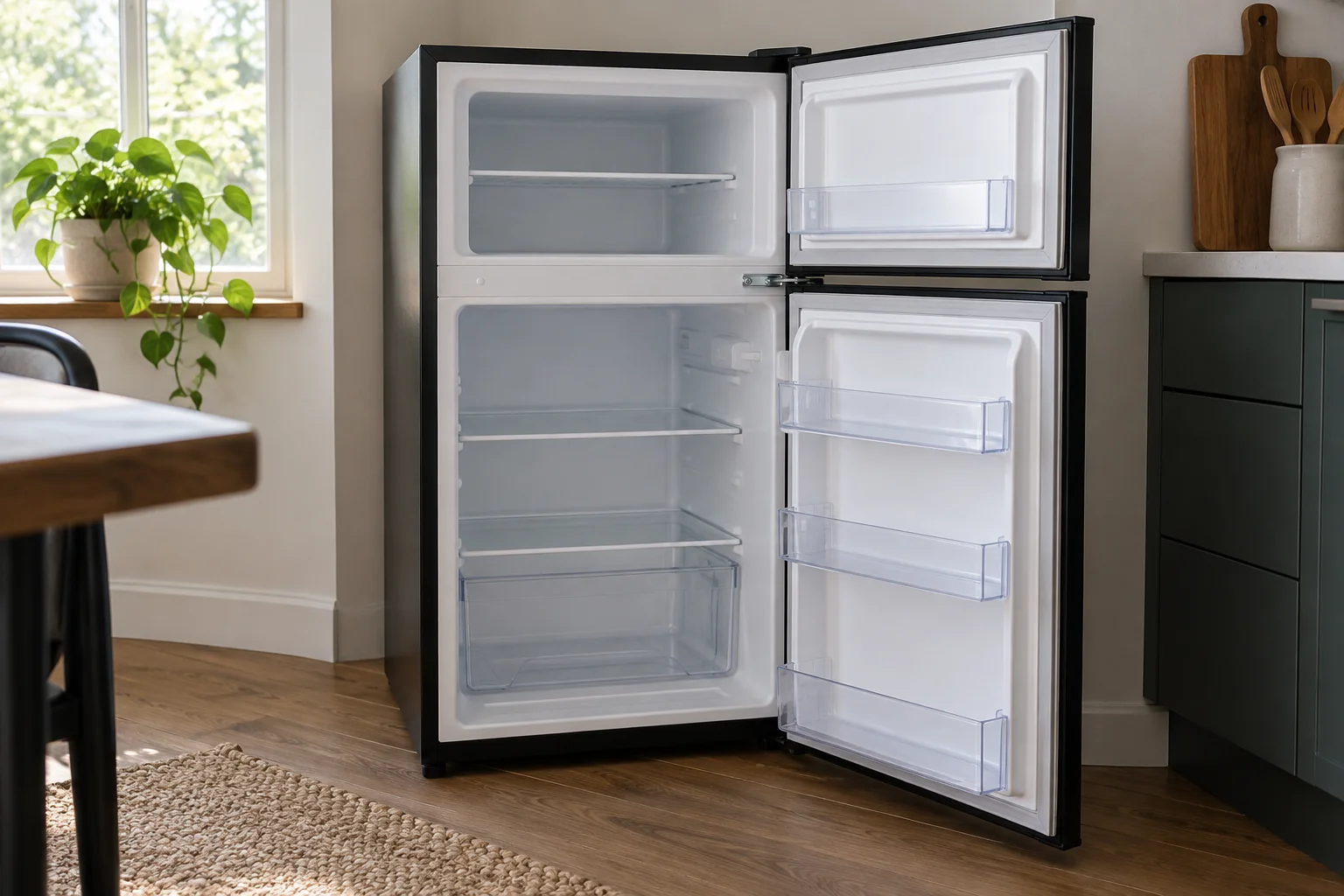
GE’s explanation of partial automatic defrost provides a useful example: on the compact models it describes, the fresh-food compartment defrosts automatically while the freezer still requires manual defrosting. The combined product name therefore does not eliminate the owner’s freezer task.
Translate the term into an ownership task
Manual defrost means you need to follow the specified owner defrost procedure when the maker’s conditions call for it. Before purchase, read what that process requires: unloading arrangements, access to any drain, floor protection, cleaning and the instructed return to operation. This guide compares the commitment; it does not substitute a generic thawing procedure.
GE’s upright-freezer guide distinguishes manually defrosted products from frost-free models that manage buildup automatically. Keep the distinction narrow. A defrost label alone does not establish a particular electricity cost, sound level or storage performance for two different models.
For a frost-free candidate, read its cleaning, airflow and fault guidance too. Automatic defrosting is a feature of the cooling system, not a promise that frost can never appear under any circumstances. Unexpected or persistent buildup belongs in the model’s troubleshooting process.
| Question | Candidate A | Candidate B |
|---|---|---|
| Exact model and region | Copy full identifier | Copy full identifier |
| Freezer defrost type | Manual, automatic or unresolved | Manual, automatic or unresolved |
| Fresh-food section, if present | Record separately | Record separately |
| Owner action trigger | Applicable manual instruction | Applicable manual instruction |
| Temporary unloading plan | Space and appropriate storage arrangements | Space and appropriate storage arrangements |
| Water management | Drain/access requirements in the manual | Drain/access requirements in the manual |
| Routine care still required | Named cleaning and inspection tasks | Named cleaning and inspection tasks |
| Unanswered issue | Question for supplier | Question for supplier |
Illustrative comparison: two doors do not settle the question
Imagine Candidate A is a compact refrigerator with a separate upper freezer door and the specification “partial automatic defrost.” Candidate B is a standalone upright freezer documented as frost-free. A buyer initially assumes both avoid manual defrosting because both listings contain an automatic-sounding term.
After reading the manuals, the buyer records that A’s freezer requires an owner defrost procedure while its fresh-food section does not. B’s freezer handles normal defrosting automatically. That changes the maintenance comparison even though the original photographs provided no obvious clue.
This is a fictional comparison of documentation, not a recommendation between particular products. The buyer still needs to compare capacity, installation conditions and other requirements independently. Neither the defrost label nor the number of doors supplies those missing answers.
Check the space needed for the maintenance plan
Think beyond the closed cabinet footprint. Can you access the relevant area and any instructed drain arrangement in the intended location? Will a door open far enough to remove the documented drawers or baskets? Ask about those requirements before placing the freezer tightly between other furniture.
Keep temporary food storage separate from a guess about how long defrosting takes. Arrange appropriate storage using current food-safety guidance and the appliance instructions; this article does not establish a safe waiting period or temperature for food. Do not buy based on an assumed one-hour maintenance window.
Likewise, do not plan to accelerate a manual procedure with a heater, sharp tool or chemical unless the exact manufacturer instructions explicitly permit the specified method. A showroom comparison should reveal the work involved, not encourage a shortcut around it.
Avoid a universal calendar
Record the trigger given in the applicable manual instead of importing a twice-yearly rule from a general buying guide. Models and conditions differ. If a seller supplies only a broad maintenance estimate, ask where it appears in the documentation for the selected unit.
After purchase, keep a simple dated record of observed buildup, completed owner care and any support advice. Describe what you see rather than diagnosing a failed component. If the observed behavior conflicts with the manual, contact support rather than repeatedly treating a possible fault as routine maintenance.
Make the purchase decision from the complete record
The useful question is whether the documented ownership tasks fit your space and routine. A manual-defrost model is not automatically a poor choice, and a frost-free model is not automatically the least expensive to operate. Compare the actual specifications and the maintenance arrangements you can provide.
Before ordering, every compartment should have a clear defrost description and every owner task should have an applicable source. If either is missing, resolve that gap before treating the appliance as a convenient fit for your household.