Key takeaways
- Protect a countertop ice maker from hard-water scale with safe water choices, cleaning intervals, filter checks and evidence-based warning signs.
Hard water is not simply “dirty” water. It contains higher concentrations of dissolved calcium and magnesium. Those minerals can form scale as water is heated, cooled, evaporated or repeatedly circulated. In a countertop ice maker, deposits may appear on the reservoir, freezing surface, pump path or sensors, contributing to slower cycles, uneven ice, noise or cleaning alerts.
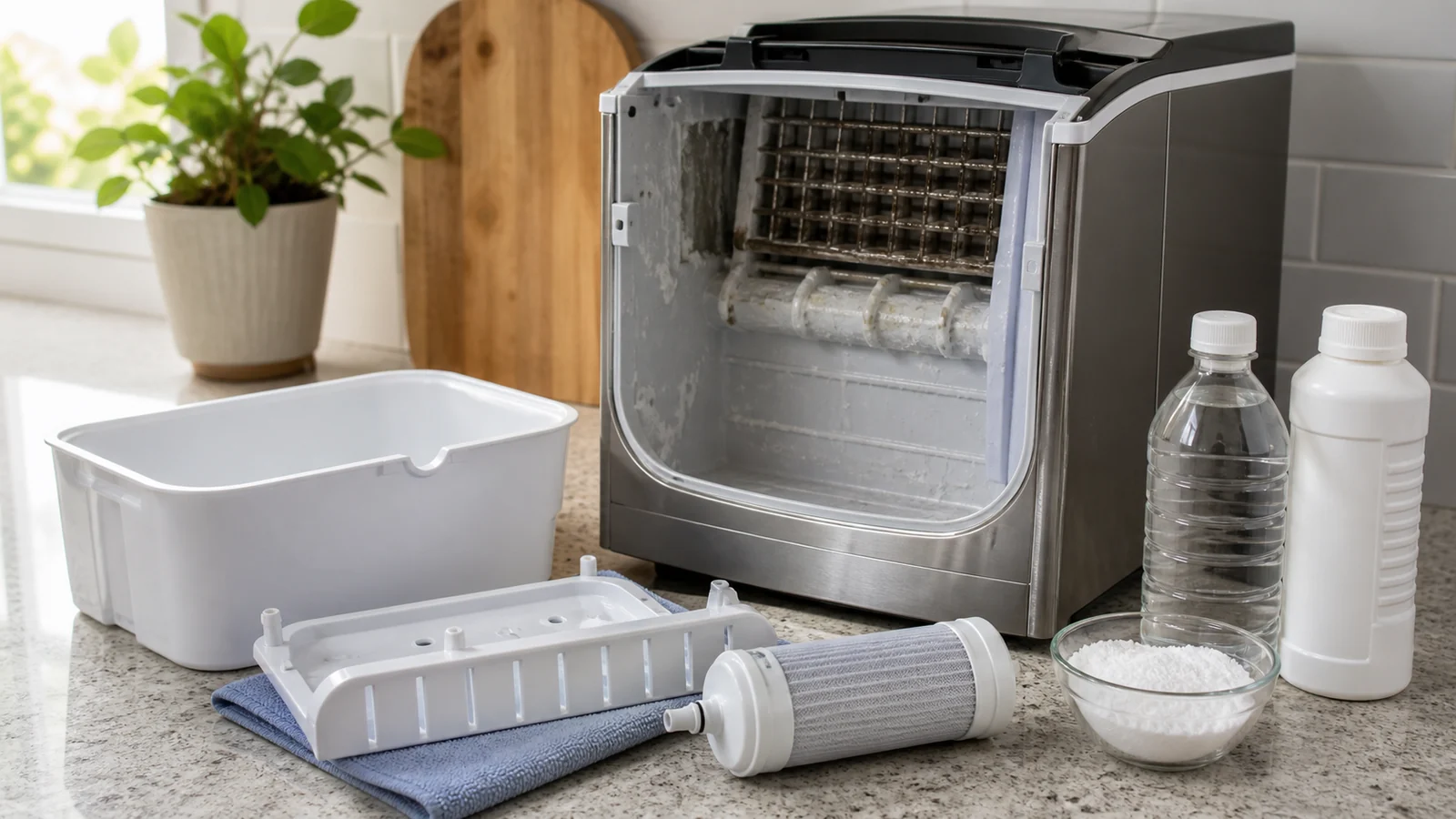
The correct response is not to pour a strong acid into the appliance or assume any filter will soften water. Start with measured local information, the exact manufacturer instructions and a repeatable maintenance log.
Our top picks




As an Amazon Associate we earn from qualifying purchases at no extra cost to you.
What hard water means
Water hardness is commonly reported as calcium carbonate concentration or in grains per gallon. Classification terms such as soft, moderately hard, hard and very hard can vary slightly by authority or context. A municipal consumer-confidence report or a properly performed water test is more useful than white spots alone.
Hardness is generally an aesthetic and operational concern rather than, by itself, proof that water is unsafe to drink. The U.S. Geological Survey’s water-hardness overview explains that calcium and magnesium are principal contributors and that scale is a common nuisance effect. Local advisories and health-based contaminant limits remain separate questions.
If a private well supplies the home, hardness is only one part of water quality. Follow local health guidance for appropriate testing; an ice maker and a taste-and-odor filter are not substitutes for determining potability.
How scale develops inside a small ice maker
Countertop machines reuse or circulate water during production. As relatively pure water becomes ice, some dissolved material remains in the liquid reservoir. Repeated cycles and evaporation can concentrate minerals. Deposits then adhere to surfaces, especially where water flow and temperature change.
The effect varies with water chemistry, machine design, usage and cleaning. A hard-water number alone cannot predict the exact number of days before scale appears. Watch the machine and follow the maker’s maximum maintenance interval rather than waiting for performance to collapse.
Signs that suggest mineral buildup
Possible signs include:
- A white, gray or chalky ring at the water line.
- Rough film on an accessible freezing or reservoir surface.
- White flakes in drained water or melted ice.
- Ice becoming progressively smaller or uneven.
- Longer cycles under otherwise similar conditions.
- Reduced visible water flow.
- A recurring add-water or ice-full warning after the sensor area clouds over.
- Increased pump sound or a cleaning reminder.
None is a definitive diagnosis. Similar symptoms can result from warm water, blocked ventilation, a filter problem, pump wear or sensor failure. Photograph changes and compare them after an authorized cleaning cycle.
Establish your actual water conditions
For public water, locate the supplier’s current water-quality report through the EPA Consumer Confidence Report resource and ask whether hardness is reported at the treatment plant or within the distribution system. Hardness may vary by source or season. A home test can add local context if performed according to its instructions.
Do not confuse total dissolved solids, conductivity and hardness. They are related measurements in some water but are not interchangeable. A simple TDS meter does not directly identify calcium and magnesium or establish drinking-water safety.
Record the source, approximate hardness, filter configuration and date. This baseline helps you see whether a maintenance change actually improved results.
Follow the appliance’s water specification
Use potable water and obey the model’s allowed temperature and water-type guidance. Some manufacturers permit filtered water; some caution against distilled water because very low conductivity may interfere with water-level sensing. Others specify a hardness range or a descaling schedule.
Never assume reverse-osmosis, distilled or softened water is automatically best. Ion-exchange softening typically replaces calcium and magnesium ions with sodium or potassium ions; it changes scale behavior but may not suit every appliance or household requirement. Reverse osmosis has a different treatment mechanism and maintenance burden.
When documentation is unclear, ask the manufacturer whether the proposed source is compatible. Preserve the answer with your appliance records.
Filters: read the certified purpose
A sediment or activated-carbon filter may improve particles, chlorine taste or odor without substantially reducing hardness. A cartridge marketed for “scale control” may use a different process from a true softener. Read the manufacturer’s performance data sheet and any third-party certification scope.
Match the filter to the actual problem. Replace it at the stated service interval or sooner when the documented conditions require it, and flush a new cartridge according to instructions. An expired cartridge can restrict flow, affecting ice size and production independently of scale.
For a directly connected machine, also verify inlet-pressure and fitting requirements. This countertop ice maker water-line overview explains why a reservoir port or drain tube should never be converted into a pressurized inlet.
Build a cleaning interval from evidence
Begin with the manual’s schedule. In harder water or heavy use, the manufacturer may call for more frequent descaling. Inspect accessible surfaces at consistent intervals and log:
- Date and number of approximate operating days.
- Water source and filter status.
- Visible scale severity.
- Cycle or output changes.
- Cleaner and concentration used.
- Number of rinse cycles.
If meaningful scale returns well before the standard interval, shorten the interval within manufacturer guidance or discuss compatible treatment with the manufacturer. Do not increase chemical strength beyond instructions to compensate for infrequent cleaning.
Descale without damaging the machine
Unplug before manual cleaning. Drain water as directed and use only the solution, dilution and contact time authorized for the model. Some manuals allow a particular vinegar dilution; others specify a nickel-safe product. The evaporator material, seals and internal coatings determine compatibility.
Avoid mixing cleaners. In particular, acids and chlorine-containing products can create dangerous reactions. Do not use abrasive pads or metal tools on freezing surfaces. Rinse for the specified number of cycles and discard the required first batches.
Our detailed countertop ice maker cleaning guide separates descaling from washing removable food-contact parts. Both matter: mineral removal does not automatically remove every organic film, and a self-clean cycle does not physically wipe the basket or lid.
Why stronger acid is not a better shortcut
Scale dissolves in acid, but uncontrolled concentration and contact time can corrode metal, damage plating, swell seals or leave residue. Lemon juice, industrial descaler and household bathroom products are not interchangeable. Never use a product merely because it removes limescale elsewhere in the home.
If the authorized cycle cannot clear heavy visible deposits, contact support. A service recommendation or part replacement is safer than scraping an evaporator or repeatedly soaking internal components.
Manage standing water and concentration
When water melts back into a reservoir and is reused, dissolved minerals can become more concentrated over successive cycles. Follow instructions for draining and refreshing water. Do not continually top up old water for days unless the manual explicitly endorses that workflow.
At the end of use, drain, clean and dry the machine. Standing water can create odor and film issues that are different from mineral scale. For storage, follow the manufacturer procedure so internal paths are emptied as fully as the user-accessible design allows.
Self-cleaning does not mean scale-proof
A self-clean program usually circulates water or solution through a defined path. It can make regular maintenance easier, but it does not change source-water hardness and may not reach every surface. The user still has to add the correct cleaner, drain, rinse, wash removable components and dry the unit.
When shopping, inspect the manual rather than relying on the button label. The products discussed in our self-cleaning ice maker guide illustrate useful features, but each still requires model-specific care.
Scale prevention for reservoir machines
For a hand-filled unit:
- Use the approved potable water source.
- Start with a clean reservoir and correct fill level.
- Refresh water on the schedule in the manual.
- Drain after use rather than leaving concentrated water standing.
- Wipe accessible water-line marks before they become thick deposits.
- Run the authorized descale cycle on schedule.
- Dry before storage.
Do not add loose treatment chemicals, salt or filter media directly to the reservoir unless the appliance maker specifically requires them.
Scale prevention for direct-connect machines
For a model explicitly designed for a water line, start with a correctly installed shutoff, approved tubing, required pressure range and any specified filter. Check joints for leaks and replace consumables on schedule. Only a qualified person should modify plumbing where code, water damage or electrical proximity creates risk.
A direct connection reduces refilling; it does not prevent scale. Because the appliance can operate for longer periods, maintenance can be easier to forget. Put filter and cleaning dates on a calendar and retain service access to the valve and drain.
What to do about white flakes in ice
Stop using the ice until the cause is assessed. Drain and inspect the machine, then clean and rinse it according to the manual. Discard affected and post-cleaning batches. Do not identify flakes by taste.
If flakes persist, photograph them and contact the manufacturer. Consider source-water testing through an appropriate laboratory when water itself has changed. Material flaking from a damaged appliance surface requires a different response from ordinary mineral scale and may make service or replacement necessary.
When performance does not recover
After proper cleaning, restore normal water temperature, room conditions, ventilation and filter flow. Compare several fresh batches. If circulation remains weak, one freezing area stays bare, errors recur or the machine leaks, scale may not be the only problem.
Stop for a damaged cord, overheating plug, repeated electrical trip, water near electrical parts or unusual mechanical grinding. Do not open the cabinet or work on sealed refrigeration components.
Frequently asked questions
Can hard water ruin a countertop ice maker?
Unmanaged scale can impair water flow, sensing and heat transfer and may contribute to premature trouble. The rate varies. Compatible water treatment plus timely, authorized descaling reduces risk but cannot guarantee appliance life.
Does cloudy ice prove the water is hard?
No. Rapid freezing can trap air and dissolved substances even in water that is not classified as hard. Use a water report or suitable test rather than appearance alone.
Can I use distilled water?
Only if the manufacturer permits it. Very low-mineral water can affect conductivity-based sensing in some machines. It also does not eliminate the need to clean wet food-contact surfaces.
Bottom line
Managing hard water is a process, not a one-time product purchase. Confirm actual hardness, use a manufacturer-compatible water source and filter, refresh standing water, inspect consistently and descale at an evidence-based interval. Avoid stronger improvised chemicals and unverified plumbing changes. Clean records and gentle, regular maintenance offer better protection than waiting for heavy scale to stop production.