
Key takeaways
- Establish stage one first: Can you hold a hollow body position for 30 seconds? If not, do that before touching a wheel, because it is the same tension pattern without the risk.
- Progress by range, not reps: Add an inch or two of rollout distance every week or two. Chasing rep counts at a fixed short range plateaus quickly.
- Keep total volume modest: Three sets of six to ten quality reps twice a week produces better results than daily high-rep sets with degrading form.
- Do not expect fat loss: Abdominal definition is a nutrition outcome. The wheel builds the muscle; whether it shows is decided elsewhere.
- Add other patterns: Rollouts train anti-extension. A complete core program also needs anti-rotation and anti-lateral-flexion work, such as carries and side planks.
What's inside
The ab wheel has a reputation problem in both directions. Some people treat it as a novelty that cannot possibly do much, and others buy one expecting visible abdominal definition within a month. Neither is right. A rollout is one of the highest-tension anti-extension exercises available, comfortably harder than most plank variations, and it recruits the lats and shoulders alongside the abdominals. It is a legitimately excellent strength exercise. It is also not a fat loss tool, and no amount of it will reveal muscle hiding under a layer of body fat.
What it will do, if you program it sensibly, is build a core that stabilizes under load, which carries over to squats, deadlifts, carries, and simply picking things up without your back complaining. The path there is a progression, not a purchase, and the right wheel depends on where you currently are on it. This roundup maps six options against the stages of that progression, from someone who cannot yet complete a knee rollout to someone working toward standing ones.
As an Amazon Associate we earn from qualifying purchases at no extra cost to you. Product prices and availability are accurate as of the date shown and are subject to change.


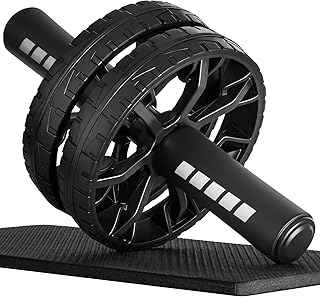
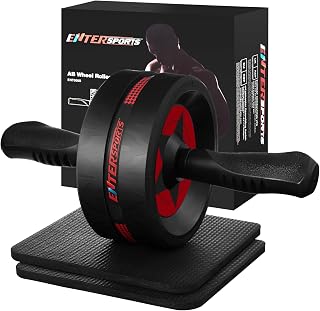

Quick Comparison
| Product | Best For | Standout Feature | Watch Out For |
|---|---|---|---|
| Abiarst Ab Roller Wheel | Stage three, full knee rollouts | No assistance, so difficulty scales with range | Too demanding for a true beginner |
| VINSGUIR Ab Roller with Knee Pad | Stage two, partial rollouts | Comfortable base for repeated practice | Requires self-imposed range limits |
| VINSGUIR Core Training Ab Roller | Stage three to four progression | Handles longer sets as capacity grows | Does nothing to protect a fatigued back |
| Upgraded Ab Roller with Knee Mat & Timer | Stage one, learning the pattern | Timer supports interval-based volume work | Assistance obscures your true starting point |
| Upgraded Rebound Ab Wheel with Elbow Support | Stage one for weaker cores | Shorter lever makes the movement achievable | Progress stalls once the movement gets easy |
| Upgraded Ab Roller with Knee Pad | Stage four, high-volume work | Durable enough for frequent long sessions | Full range demands genuine core control |
How to Choose
- Establish stage one first: Can you hold a hollow body position for 30 seconds? If not, do that before touching a wheel, because it is the same tension pattern without the risk.
- Progress by range, not reps: Add an inch or two of rollout distance every week or two. Chasing rep counts at a fixed short range plateaus quickly.
- Keep total volume modest: Three sets of six to ten quality reps twice a week produces better results than daily high-rep sets with degrading form.
- Do not expect fat loss: Abdominal definition is a nutrition outcome. The wheel builds the muscle; whether it shows is decided elsewhere.
- Add other patterns: Rollouts train anti-extension. A complete core program also needs anti-rotation and anti-lateral-flexion work, such as carries and side planks.
Top Picks Reviewed
Best Mid-Progression Wheel: Abiarst Ab Roller Wheel
Once you can complete controlled knee rollouts to about two-thirds range, an unassisted wheel becomes the right tool. Difficulty scales naturally with how far you extend, so a single simple product covers a long stretch of progress.
Handed to someone at stage zero it is genuinely too hard, and the failure mode is collapsing forward with an arched back. Earn your way to this one.
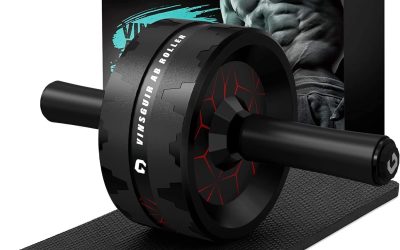
Best Practice Platform: VINSGUIR Ab Roller with Knee Pad
Comfortable kneeling means you can accumulate the repetitions that actually build the pattern. At the partial-range stage, volume of quality reps is what drives adaptation, and comfort is what allows volume.
Nothing about the design limits your range, so the discipline has to come from you. Use a wall as a physical stop rather than trusting your judgment mid-set.
Best Long-Run Option: VINSGUIR Core Training Ab Roller
As sets get longer and range increases, a wheel that stays stable and predictable lets you keep pushing without the equipment becoming the variable. This covers the middle and later stages well.
It offers no protection when you fatigue. The last reps of a long set are where the lower back takes over, and this design will let you do them badly.
Best for Learning: Upgraded Ab Roller with Knee Mat & Timer
For someone at the very start, assisted return plus timed intervals is a structured, safe way to learn what the movement feels like and to build initial capacity without failing repeatedly.
Assistance makes it hard to know your real baseline. When you eventually move to an unassisted wheel, expect your usable range to be considerably shorter than you had come to believe.
Best Entry Point: Upgraded Rebound Ab Wheel with Elbow Support
A shorter lever arm makes the rollout achievable for people who genuinely cannot do one otherwise, which turns the wheel from an aspirational purchase into a usable tool from day one.
You will outgrow it. Once the supported version becomes easy, there is no way to make it harder, and progress stops until you move to a standard wheel.
Best for Volume Training: Upgraded Ab Roller with Knee Pad
At the stage where you are doing sets of ten to fifteen full-range knee rollouts several times a week, durability and comfortable padding matter. This handles that workload.
Full-range work at high volume is unforgiving. Cut the set when your form changes rather than when you hit the number, because the reps after that point are where injuries happen.
Frequently Asked Questions
Does an ab roller actually work?
Yes, as a strength exercise. Rollouts generate high abdominal tension and also train the lats and shoulders. What they do not do is burn fat from the midsection specifically.
How many ab wheel reps should I do?
Three sets of six to ten controlled reps, two or three times a week, is a productive dose for most people. Quality of range matters far more than the count.
How long before I see results?
Strength improvements show within four to six weeks as increased rollout range. Visible definition depends on body fat and follows a nutrition timeline, not a training one.
Can I do ab wheel work every day?
Better not to. The connective tissue involved recovers slowly and the soreness is notably persistent. Two or three sessions a week is plenty.
Final Thoughts
Buy the wheel that matches your current stage, then let range rather than reps be the measure of progress. Assisted designs are the right answer if you cannot yet complete a rollout and the wrong answer if you can. Whichever you choose, treat it as a strength exercise with a real progression, not as a shortcut to a visible midsection.
Write Your Review
No reviews yet. Be the first to share your experience!