
Key takeaways
- Measure the opening, not the door. A “30-inch door” describes the slab, not the finished opening or the trimmed exterior. Leverage bars clamp to the outside of the casing, so the trim-to-trim measurement is the one that decides fit. Compare it to the manufacturer’s stated range, not a rounded guess.
- Check casing depth and profile. Over-frame hooks are designed for casing that projects roughly 1/2 to 1 inch from the wall with a flat face. Ornate colonial trim, rounded bullnose, or arched openings prevent the hook from seating square, which is what causes that unsettling lateral shift mid-set.
- Confirm head and heel clearance. Standard openings top out around 80 inches. If you’re 6 feet tall you need at least a few inches above the bar for your chin and enough below for bent knees — measure floor to bar, then subtract your torso reality. Bracket-mounted bars that sit above the frame buy back the clearance telescoping bars take away.
- Verify the frame, not just the bar rating. A bar rated to 300 pounds is meaningless if it’s hanging on a hollow-jamb builder-grade frame with finish nails. Press upward on the header; if the casing flexes or you hear nails move, choose a screw-mounted bracket that lands in framing lumber.
- Match grip geometry to your goals. Neutral and angled grips reduce elbow and shoulder strain considerably compared with a single straight tube. If you plan to do push-ups, dips, or sit-up anchoring with the same unit, prioritize bars with removable floor-mode capability.
What's inside
Most doorway pull-up bar returns have nothing to do with the bar. They happen because someone ordered a 36-inch leverage-mount unit for a 30-inch bathroom doorway, or bolted a bracket against decorative casing that sticks out 1/4 inch and watched the whole thing rock sideways on the first rep. Before you look at a single product page, grab a tape measure and write down four numbers: the inside width of the door opening, the width of the trim from outer edge to outer edge, the depth of the casing where it meets the wall, and the distance from the top of the opening to the ceiling. Those four numbers eliminate roughly half the market instantly and turn this from a gamble into a purchase.
Doorway bars split into two mechanical families, and they fail in different ways. Leverage-mount bars hook over the top of the frame and press a padded arm against the wall above the door, converting your body weight into downward clamping force — no drilling, but they demand flat wall space above the opening and they can dent drywall if the pads are cheap. Telescoping in-frame bars wedge inside the jamb using threaded expansion or screw-in brackets, sit lower, and give you nothing for leg clearance unless your frame is unusually tall. Neither type is universally better. The right one depends on your ceiling height, whether you’re allowed to put screws in the wall, and how much you weigh relative to what the frame can take.
As an Amazon Associate we earn from qualifying purchases at no extra cost to you. Product prices and availability are accurate as of the date shown and are subject to change.

#1 Pick

#2 Pick


#4 Pick

#5 Pick

#6 Pick

#7 Pick

Quick Comparison
| Pick | Mount Type | Typical Frame Fit | Trim Requirement | Best For |
|---|---|---|---|---|
| Iron Gym Total Upper Body Bar | Leverage over-frame | 24–32 in openings | Flat casing, minimal proud edge | First-time buyers, narrow doorways |
| ProsourceFit Multi-Grip Bar | Leverage over-frame | 27–36 in openings | Needs clean wall above door | Grip variety on a budget |
| Perfect Fitness Multi-Gym Pro | Leverage, wide load plates | 24–36 in openings | Tolerant of thicker trim | Heavier lifters, drywall protection |
| Ultimate Body Press Doorway Bar | Bracket-mounted, elevated | Most standard frames | Screws into studs/frame | Deep clearance, tall users |
| Yes4All Telescoping Chin-Up Bar | In-frame expansion | Adjustable across common widths | Solid jambs, no trim contact | Renters, storage-conscious setups |
How to Choose
- Measure the opening, not the door. A “30-inch door” describes the slab, not the finished opening or the trimmed exterior. Leverage bars clamp to the outside of the casing, so the trim-to-trim measurement is the one that decides fit. Compare it to the manufacturer’s stated range, not a rounded guess.
- Check casing depth and profile. Over-frame hooks are designed for casing that projects roughly 1/2 to 1 inch from the wall with a flat face. Ornate colonial trim, rounded bullnose, or arched openings prevent the hook from seating square, which is what causes that unsettling lateral shift mid-set.
- Confirm head and heel clearance. Standard openings top out around 80 inches. If you’re 6 feet tall you need at least a few inches above the bar for your chin and enough below for bent knees — measure floor to bar, then subtract your torso reality. Bracket-mounted bars that sit above the frame buy back the clearance telescoping bars take away.
- Verify the frame, not just the bar rating. A bar rated to 300 pounds is meaningless if it’s hanging on a hollow-jamb builder-grade frame with finish nails. Press upward on the header; if the casing flexes or you hear nails move, choose a screw-mounted bracket that lands in framing lumber.
- Match grip geometry to your goals. Neutral and angled grips reduce elbow and shoulder strain considerably compared with a single straight tube. If you plan to do push-ups, dips, or sit-up anchoring with the same unit, prioritize bars with removable floor-mode capability.
Top Picks Reviewed
Iron Gym Total Upper Body Workout Bar
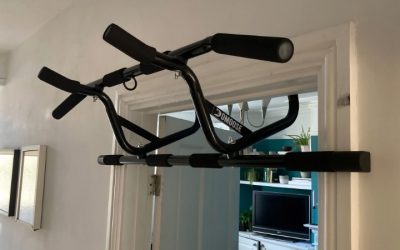
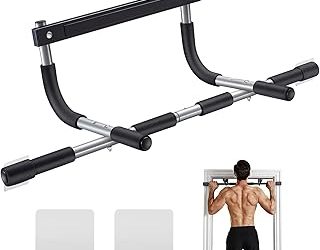
The unit that defined the category, and still the safest bet for narrow doorways where wider models simply won’t span. It handles openings in the two-and-a-half-foot range that defeat most competitors, and the tool-free assembly takes about ten minutes with the included hardware. The tradeoff is a modest weight ceiling and a narrower grip spread, so tall or heavy users may feel the frame flex more than they’d like. It doubles as a floor platform for push-ups and dips, which earns its keep in small apartments.
ProsourceFit Multi-Grip Chin-Up Bar
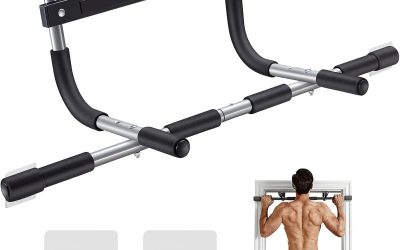
Three grip positions — wide, neutral, and close — on a frame that fits most standard residential openings without modification. The foam sleeves are dense enough to survive months of chalk-free hands, and the upper wall pad spreads pressure well enough to avoid the classic pair of drywall dents. It needs a genuinely flat stretch of wall above the door; if you have a transom, a wall-mounted thermostat, or crown returns intruding into that zone, look elsewhere.
Perfect Fitness Multi-Gym Pro
The pick for anyone north of 200 pounds. Broad steel load plates distribute clamping force across a much larger drywall footprint, and the ergonomic grip angles noticeably reduce wrist strain on high-volume sets. Its adjustable width accommodates both cramped hallways and wide living-room passages. Assembly is fussier than the competition — expect to fine-tune the wall arm twice before it sits truly flush — but once dialed in, it’s the most confidence-inspiring no-drill option here.
Ultimate Body Press Doorway Pull Up Bar
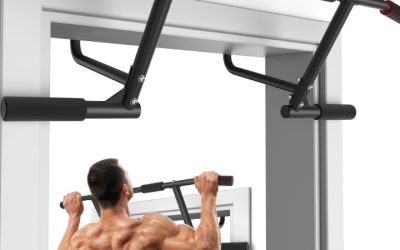
This one mounts with screws above the door and positions the bar forward of the frame, which solves the two problems doorway bars usually can’t: knee clearance and knuckle scrape. If you’re over six feet and tired of tucking into a shrimp position, the extra standoff distance is transformative. You will be drilling into framing, so it’s not a rental-friendly choice, and you should locate solid wood before committing. Multiple grip stations make it the closest thing to a wall-mounted bar without a wall-mount footprint.
Yes4All Telescoping Doorway Chin-Up Bar
A simple expanding tube that adjusts across a wide span and lifts out in seconds when guests come over. Because it wedges inside the jamb, it demands solid, square jambs and leaves no trim marks whatsoever — the strongest argument for renters with strict lease language. Clearance is the limitation: with the bar sitting inside the opening, most adults will need to bend their knees sharply. Treat it as a dead-hang and chin-up tool rather than a full apparatus.
Frequently Asked Questions
Will a leverage-mount bar damage my door frame or wall?
Properly fitted, it shouldn’t. Damage comes from three sources: pads that are too small for the force applied, a bar mounted on casing it wasn’t sized for, and kipping or swinging that introduces shear load. Add a strip of thin plywood or a felt pad behind the upper arm, keep your reps controlled, and inspect the casing monthly for compression marks.
What if my measurement falls between two size ranges?
Size down toward the model that lists your opening comfortably inside its range rather than at the extreme edge. Bars operating at their maximum span sit with less hook engagement, which is exactly where lateral slip begins. If you’re between ranges, an adjustable-width model removes the guesswork.
Can I use these bars for hanging leg raises and ab straps?
Only with clearance to spare and a screw-mounted or heavy-duty leverage design. Leg raises shift your center of mass forward and add dynamic load, which is the worst-case scenario for a friction-dependent mount. If ab work is central to your training, choose the bracket-mounted option and add straps.
Do these work on metal or steel-framed doorways?
Often, but verify the casing profile first. Commercial-style steel frames typically have a narrow, tightly radiused edge that gives over-frame hooks very little to bite. In those cases a telescoping in-frame bar sized to the jamb or a separate wall-mounted unit is the more reliable answer.
Final Thoughts
A doorway pull-up bar is one of the highest-return pieces of home equipment you can own, costing less than a month of gym membership and occupying zero floor space. The catch is that it’s a fit-dependent product masquerading as a universal one. Spend five minutes with a tape measure on your opening width, trim depth, and headroom, decide whether you can put screws in the wall, and the correct pick usually becomes obvious. Choose the model that fits comfortably inside its stated range rather than at the limit, mount it carefully, and hang on it once with both feet on the floor before you trust it with your full weight.

Write Your Review
No reviews yet. Be the first to share your experience!