
Key takeaways
- Match gauge to your ceiling, not your ego. If your working squat sits under 300 pounds and will stay there, 12- or 14-gauge is honest value. If you plan to chase a 400-plus pound bar, 11-gauge is the floor.
- Check hole spacing in the bench zone. Westside spacing — roughly 1-inch increments through the pressing range — lets you set J-cups and safeties precisely instead of settling for “close enough.”
- Confirm hardware diameter before you buy accessories. Rack ecosystems are built around 5/8-inch or 1-inch pins. Mixing brands rarely works, so the hole size you pick today decides which spotter arms, dip bars, and landmines you can buy later.
- Budget vertical clearance, then horizontal. Leave 4 to 6 inches above the pull-up bar for your hands and head, and 24 to 30 inches behind the cage if you want plate horns loaded from the rear.
- Decide freestanding or bolted early. Wide base feet and a stabilizer bar let a cage stand on rubber flooring. Narrow-footprint cages and most wall-adjacent builds want lag bolts into a slab or joists.
What's inside
Steel gauge is a countdown, not a count-up: 14-gauge tubing has a wall about 0.075 inches thick, 12-gauge climbs to roughly 0.105 inches, and 11-gauge lands near 0.120 inches. That sliver of difference is the whole argument in the power cage market. Pair 11-gauge with a 3×3-inch upright and 5/8-inch hardware and you get a cage that barely acknowledges a 500-pound squat. Pair 14-gauge with a 2×2-inch upright and you still get a usable rack for most lifters, just one that flexes a little when a bar is racked hard and that caps out sooner than the plates in your collection will.
Space is the other half of the equation, and it is less forgiving than steel. A cage with an 80-inch upright wants a ceiling near 8 feet for comfortable pull-ups; a 93-inch upright needs a basement, not a spare bedroom. Depth matters more than most buyers expect: a 30-inch interior is enough to squat and bench, while a 41-inch interior gives you room to leave a bench parked inside and still walk out with the bar. Add plate storage horns and you push another 8 to 12 inches into the room behind you. Measure before you shop, and confirm current specs on the listing, since manufacturers quietly revise hardware and hole patterns between production runs.
As an Amazon Associate we earn from qualifying purchases at no extra cost to you. Product prices and availability are accurate as of the date shown and are subject to change.

#1 Pick

#2 Pick

#3 Pick
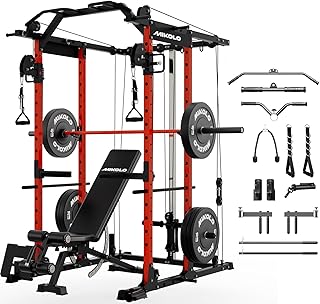
#4 Pick

#5 Pick

#6 Pick

#7 Pick

As an Amazon Associate we earn from qualifying purchases at no extra cost to you. Product prices and availability are accurate as of the date shown and are subject to change.
#1 Pick
Quick Comparison
| Model | Tubing / Gauge | Hardware | Approx. Footprint | Best For |
|---|---|---|---|---|
| REP Fitness PR-4000 | 3×3 in, 11-gauge | 5/8 in bolts, 1 in holes | ~48 x 30–41 in | Heavy lifters, long-term builds |
| Rogue R-3 | 2×3 in, 11-gauge | 1 in hardware | ~49 x 53 in | Tight rooms with heavy loads |
| Titan T-3 Series (Tall) | 2×3 in, 11-gauge | 5/8 in bolts, 1 in holes | ~50 x 50 in | Best strength per dollar |
| Bells of Steel Hydra | 3×3 in, 11-gauge | 5/8 in bolts, 1 in holes | Varies by config | Modular, attachment-heavy setups |
| REP Fitness PR-1100 | 2×2 in, 14-gauge | 5/8 in bolts | ~48 x 48 in | Entry-level full cage |
| Fitness Reality 810XLT | 2×2 in steel | Pin-style adjusters | ~46 x 48 in | Smallest budget and footprint |
How to Choose
- Match gauge to your ceiling, not your ego. If your working squat sits under 300 pounds and will stay there, 12- or 14-gauge is honest value. If you plan to chase a 400-plus pound bar, 11-gauge is the floor.
- Check hole spacing in the bench zone. Westside spacing — roughly 1-inch increments through the pressing range — lets you set J-cups and safeties precisely instead of settling for “close enough.”
- Confirm hardware diameter before you buy accessories. Rack ecosystems are built around 5/8-inch or 1-inch pins. Mixing brands rarely works, so the hole size you pick today decides which spotter arms, dip bars, and landmines you can buy later.
- Budget vertical clearance, then horizontal. Leave 4 to 6 inches above the pull-up bar for your hands and head, and 24 to 30 inches behind the cage if you want plate horns loaded from the rear.
- Decide freestanding or bolted early. Wide base feet and a stabilizer bar let a cage stand on rubber flooring. Narrow-footprint cages and most wall-adjacent builds want lag bolts into a slab or joists.
Top Picks Reviewed
REP Fitness PR-4000
This is the rack you buy once. The 3×3-inch, 11-gauge uprights with 5/8-inch hardware feel inert under load, and you configure height (80 or 93 inches) and depth (roughly 30 or 41 inches) to your room rather than the reverse. The trade-off is assembly time and shipping weight — expect a couple of hours with a socket wrench and a friend. If you already own a bench, a barbell, and 400 pounds of plates, the PR-4000 is the last cage in the sequence.
Rogue R-3
The R-3 solves a specific problem: heavy training in a room that will not accept a 41-inch-deep cage. A 30-inch interior depth keeps the overall footprint tight while 2×3-inch, 11-gauge steel and 1-inch hardware handle serious weight. Fit and finish are the reason for the price — laser-cut holes line up, and the powder coat holds up to chalk and bar knurl. Attachment support is deep, though the 1-inch pin standard locks you into Rogue’s catalog.
Titan T-3 Series (Tall)
Titan’s T-3 delivers 11-gauge steel and Westside bench spacing at roughly half the cost of the premium options. Tolerances are looser — expect to ream or wiggle a bolt or two during assembly — but once it is together, the cage is genuinely stable and rated well past what most home lifters will load. The tall version clears comfortable kipping and pull-up work if you have the headroom. For value per pound of steel, nothing here beats it.
Bells of Steel Hydra
The Hydra treats a cage like a platform rather than a finished product. You choose upright height, interior width, and depth, then keep bolting on gear: a lat tower, a leg roller, a landmine, weight horns. The 3×3-inch, 11-gauge frame with 5/8-inch hardware puts it in the same structural class as the PR-4000. Pick it if your plan is to grow a full gym around one frame over several years instead of buying separate machines.
REP Fitness PR-1100
The PR-1100 is the sensible starting point for a first barbell setup. It uses 2×2-inch, 14-gauge tubing with 5/8-inch hardware and a four-post design that includes real safety pins — not straps or plastic. It will move slightly on a hard rack, and it is not the cage for a 500-pound squat, but for a novice through intermediate lifter working in a garage corner, it is a legitimate cage at a beginner price.
Fitness Reality 810XLT Super Max
The lowest barrier to entry on this list. The 810XLT uses lighter 2×2-inch tubing with pin-adjusted J-hooks and safeties, and its 800-pound rating means the frame, not you, sets the limit. Take it for what it is: a compact, inexpensive cage that lets someone squat and bench safely alone in a small space today. Many owners outgrow it, but “outgrew my first cage” is a good problem to have.
Frequently Asked Questions
Do I have to bolt my power cage to the floor?
Not always. Cages with wide base feet and front-to-back stabilizers stay planted for squats and presses. Bolt down if you do rack pulls, band work, or heavy kipping, or if the cage has a narrow footprint — those loads create tipping forces that plate storage alone will not counteract.
Is 14-gauge steel strong enough for a serious lifter?
For squats and presses under roughly 300 pounds, yes. Above that, you will notice deflection when the bar is racked, and stated capacity ratings assume evenly distributed static load rather than a bar dropped into J-cups. Lifters heading toward 400 pounds should go straight to 11-gauge.
What ceiling height do I need?
An 80-inch cage works under an 8-foot ceiling with room to grip the pull-up bar. Anything taller belongs in a basement or garage with 9-plus feet. Also account for rubber flooring, which can steal three-quarters of an inch, and any overhead lights or garage door tracks in the swing path.
How is a power cage different from a half rack?
A power cage has four uprights and lets you lift inside it, with safeties on both sides of your body. A half rack has two uprights and forward spotter arms, so you lift in front of the frame. Cages are safer for solo training; half racks save floor depth and cost less.
Final Thoughts
Pull out a tape measure before you compare prices. Once you know your ceiling clearance, usable depth, and how much room you need to walk a bar out, the field narrows fast. From there the decision is simple: 11-gauge and 3×3-inch uprights if heavy barbell work is your long game, 2×3-inch 11-gauge if you want that strength in a tighter footprint, and a well-built 14-gauge cage if you are starting out and would rather spend the difference on plates.
FAQ
Do I have to bolt my power cage to the floor?
Is 14-gauge steel strong enough for a serious lifter?
What ceiling height do I need?
How is a power cage different from a half rack?
Best Robot Vacuum with Self Emptying Station for Pet Hair in 2026: Tested and Ranked
Living with furry companions brings immense joy, but dealing with relentless shedding...
Best Gym Mat for Home: Rubber vs Foam Picks for Any Floor
Best gym mat for home choices come down to material density and...
Best Rowers for Home Gym: Air, Magnetic and Water Compared
Best rowers for home gym shortlists usually collapse once someone measures the...
Best Weight Home Gym: 6 All-in-One Machines for Small Rooms
Best weight home gym decisions come down to two numbers before brand...
Best Home Gym Equipment for Beginners: The Starter Setup
Best home gym equipment for beginners is not a machine – it...
Best Treadmills for Home Gym: 5 Picks by Deck and Motor
Best treadmills for home gym decisions come down to two specifications and...
Best Home Gym Compact Setups: 6 Space-Saving Picks Ranked
Best home gym compact claims usually quote a stored footprint and stay...
Best Adjustable Bench for Home Gym: 5 Picks Ranked by Use
Best adjustable bench for home gym decisions turn on three numbers most...
Best Cable Machine for Home Gym: 5 Picks and Pulley Ratios
Best cable machine for home gym shortlists collapse quickly once you convert...
Best Cable Machines for Home Gym: 5 Types and Their Limits
Best cable machines for home gym use are not one product category...
Write Your Review
No reviews yet. Be the first to share your experience!